Why Bounce Workouts Make You Leak After Baby and How to Stop It

Quick Answer: Leaking during postpartum bounce workouts usually means the pelvic floor is not yet handling sudden downward pressure. The fix starts with lower-impact moves, timed breathing, and a short pelvic floor routine. Most people see improvement within several weeks of steady practice, but any leak that keeps happening deserves a check with a pelvic floor physical therapist.
You finally carved out time for a workout, and then you jumped once and felt that unmistakable warning. It is embarrassing, and it can make you want to quit moving altogether. Please do not. There are straightforward ways to make the workout work for your body right now.

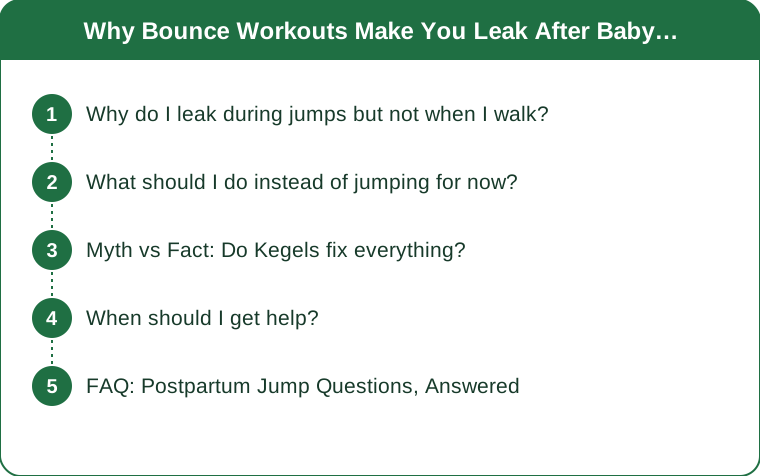
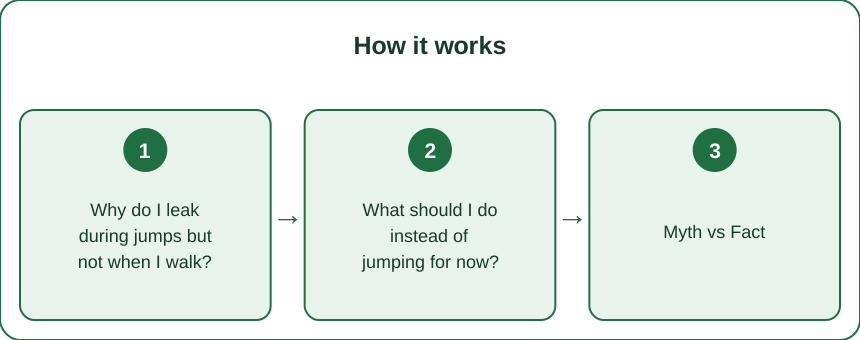
Why do I leak during jumps but not when I walk?
Walking sends a gentle load through the pelvis one step at a time. Jumping sends a sudden, repeated spike of pressure downward, and the pelvic floor has to catch it every time. In the postpartum months, that catch may be slower or weaker than before, so small leaks show up under impact.
It is a timing and strength issue, not a personal failing. The good news is that the system can be trained.
What should I do instead of jumping for now?
Choose lower-impact moves while your pelvic floor rebuilds. Try step-outs, marching, low lunges, or a cycling session, and keep the intensity moderate. Choose a sports bra with good support, and bring a pad or liner until you feel steadier.
When you do add a little impact, try exhale on effort. Breathe out as you lift or step, and keep the jump small and controlled. Stop if you feel pressure, heaviness, or a leak.

Myth vs Fact: Do Kegels fix everything?
Myth: A few Kegels a day will solve any leak. Fact: Pelvic floor work helps most when it is coordinated with breath and load, and some people actually need to learn to relax the floor too.
Fact: A short routine of gentle squeezes, full releases, and breath work usually does more than hard squeezing alone. A specialist can check which pattern you need.
When should I get help?
See a pelvic floor physical therapist or your doctor if you leak during everyday activities like coughing or walking, notice heaviness or pressure in the pelvis, have pain during intimacy, or see no change after about six weeks. Those signs are common and very treatable.
This is general information, not medical advice.
FAQ: Postpartum Jump Questions, Answered
Can I go back to running after a leak?
Many people return to running in stages once the leak settles and a provider gives clearance. Start with walk-run intervals and stop if leaking returns.
Are special underwear or pads a good idea?
They can make daily life easier while you rebuild, and there is nothing wrong with using them. They do not replace the training.
Will this get better on its own?
Some people improve with time, but many need a structured plan. Getting help early tends to make the recovery shorter.
TL;DR:
- Leaking during bounce workouts means your pelvic floor is still catching sudden pressure.
- Swap jumps for step-outs, marching, low lunges, or cycling for now.
- Exhale on effort and keep any impact small and controlled.
- Use a supportive bra and pads while you rebuild.
- See a pelvic floor specialist if leaks continue or you notice pressure or pain.
Your body did something incredible, and it deserves a patient rebuild. Move in ways that feel steady, and bring the jumps back when your floor says yes. This is general information, not medical advice.
See It in Motion
Seen here: Maternity Capris with Side Pockets — shop it on bubblelime.com
Keep Reading
This article is for general informational and styling purposes only. Fit, sizing, and product availability may vary.