Postpartum Breathing Is the Core Exercise Nobody Prescribes

Quick Answer: Your diaphragm and pelvic floor move together — the diaphragm descends on the inhale and the pelvic floor lengthens with it, then both recoil on the exhale. Pregnancy changes rib position and breathing pattern, and if that is not restored, pelvic floor exercises are working against a system that is not coordinating. Ten minutes a day of positional breathing usually unlocks more progress than adding more Kegels.
You have been doing the pelvic floor exercises. Diligently. For months.
And something still is not right — the heaviness, the leaking on a sneeze, the core that will not switch on. The missing piece is usually two floors up.

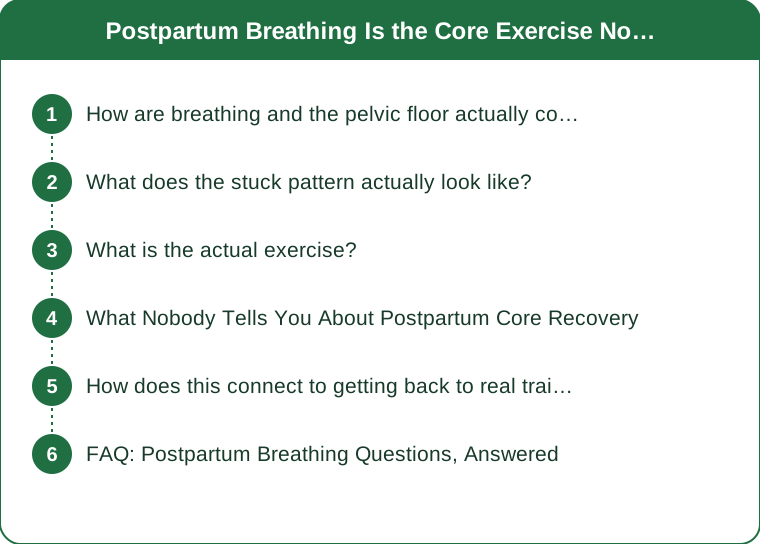
How are breathing and the pelvic floor actually connected?
They are the top and bottom of the same pressurised container.
Your abdominal cavity is a closed system bounded by the diaphragm above, the pelvic floor below, the deep abdominals in front and around, and the spine behind. Pressure inside it has to go somewhere, and the walls of the container manage that together.
On a normal inhale, the diaphragm contracts and descends. Pressure in the abdomen rises slightly, and the pelvic floor lengthens and descends with it — this is normal and correct, not a weakness. On the exhale, the diaphragm recoils upward and the pelvic floor rises back with it.
That coordination is automatic when the system is working. It is a reflex, not something you consciously drive.
Pregnancy disrupts it mechanically. The growing uterus pushes the diaphragm upward, the ribs flare outward to make room, and the breathing pattern shifts toward the upper chest because the lower ribs cannot expand the way they used to. After delivery the pressure is gone but the pattern often stays, because it has been the habit for months.
The result is a diaphragm that is not descending well, a pelvic floor that is not being loaded and unloaded rhythmically, and abdominals that are being asked to brace against a system that is not managing pressure properly.
What does the stuck pattern actually look like?
You can usually spot it in about thirty seconds.
Signs the pattern has not reset:
- Shoulders rise visibly on the inhale
- The belly moves but the lower ribs do not widen sideways
- The lower ribs are visibly flared outward at rest, with the front ribs angled up rather than down
- You hold your breath during any effort — lifting the car seat, standing from the floor
- The belly domes or cones outward under load
- Heaviness or leaking that has not improved despite consistent pelvic floor work
What normal looks like: on an easy inhale, the lower ribs widen laterally and the back ribs expand into the floor, the belly softens slightly, and the shoulders stay still. On the exhale everything returns without effort.
Put your hands on your lower ribs, thumbs toward the back, and breathe. If your hands do not move apart, that is the thing to work on. This is not a strength problem and more repetitions of anything will not fix it.
What is the actual exercise?
It is unglamorous and it takes ten minutes. Start here and do it daily for two weeks before adding anything.
Position: lie on your back, knees bent, feet flat, a small cushion under your head. Rest your feet up on a sofa or chair so hips and knees are at roughly 90 degrees — this position takes tension out of the hip flexors and lets the ribs settle down.
Step 1 — find the ribs. Hands on the lower ribs, thumbs toward the back. Inhale gently through the nose for a count of four and aim the breath into your hands and into the floor behind you. Do not push the belly out; let it soften.
Step 2 — exhale long. Out through pursed lips for a count of six to eight. As you exhale, feel the lower ribs drop down and in. Do not force the abdominals to squeeze.
Step 3 — add the connection. After four or five breaths, on the exhale only, add a gentle pelvic floor lift — the sensation of stopping wind, not a maximal squeeze. Let it release completely on the inhale. The release is as important as the lift, and it is the part almost everyone skips.
Dose: 10 breaths, 3 times a day, or one 10-minute session. Every day.
Then progress the same breath into positions that are harder — side-lying, all fours, sitting, standing, and finally into movement.

What Nobody Tells You About Postpartum Core Recovery
Rib position is often the whole story. A rib cage that stayed flared after pregnancy puts the diaphragm at a mechanical disadvantage, and no amount of abdominal work fixes it directly. Breathing does.
Over-gripping is as much a problem as weakness. A lot of postpartum pelvic floors are not weak — they are held tight all the time and cannot relax enough to generate a proper contraction. If you have been squeezing constantly for months, more squeezing makes it worse. This is why some people get worse with diligent Kegels, and it is the most under-explained thing in the whole area.
Breath-holding under load is the daily culprit. Not the workout. The twenty times a day you lift a car seat, a toddler, or a laundry basket while holding your breath. Exhaling on effort is the single highest-value habit change available.
Timeline is longer than the six-week appointment implies. Connective tissue remodelling continues for six to twelve months, and longer while breastfeeding, because of the hormonal effect on tissue laxity. The six-week clearance means the wound has healed, not that the system has reorganised.
This applies after a caesarean too, and often more so. Abdominal surgery changes how the trunk is used for months, and the breathing pattern is usually the last thing to come back.
How does this connect to getting back to real training?
It is the gate. Everything downstream works better once it is in place, and most of the classic postpartum training failures are pressure management failures wearing a different name.
A reasonable progression:
Stage 1 — restore the pattern (2 to 4 weeks). Positional breathing daily. No abdominal work beyond the connected exhale.
Stage 2 — load it lightly (3 to 4 weeks). Same breath in all fours, side-lying, and standing. Add dead bug and bird dog variations, timed to the exhale. Watch for doming — if the belly cones, regress.
Stage 3 — add real load (ongoing). Carries, squats, hinges, presses — all with an exhale on the effort. Loaded carries are particularly good here because they demand pressure management continuously rather than in a single rep.
Stage 4 — impact. Only when you can do stage 3 with no leaking, no heaviness, and no doming, and when single-leg control is solid. Running is a series of one-legged landings, and returning to it before pressure management is reliable is the most common way this goes wrong.
If leaking, heaviness, pain, or doming persists through this progression, that is a pelvic health physiotherapist referral, not a reason to try harder. This is general information, not medical advice, and an internal assessment tells you things no article can.
FAQ: Postpartum Breathing Questions, Answered
How long until I notice a difference?
Many people feel a change in how their trunk works within one to two weeks, which is faster than most postpartum interventions. Symptom change — leaking, heaviness — usually takes six to twelve weeks of consistency.
Is it too late if I am two years postpartum?
No. The pattern is a habit, not a deadline, and it responds at any point. Plenty of people find this out years later and get the same result.
Do I still need pelvic floor exercises?
Yes, but coordinated with breath rather than done as isolated squeezes, and with equal attention to the release. If you have been told you are over-gripping, the emphasis shifts toward downtraining and that should be guided by a physio.
I have diastasis. Does this help?
It is usually the appropriate starting point, because managing intra-abdominal pressure is what allows the linea alba to generate tension. It is not a substitute for a proper assessment of the gap and its depth.
Can I do this while feeding or holding the baby?
The full positional version needs the floor, but the breathing itself works sitting upright with the same rib focus, and doing it while feeding is a realistic way to actually get the reps in.
TL;DR:
- Diaphragm and pelvic floor work as one pressurised system and coordinate automatically when the pattern is intact
- Pregnancy leaves many people in an upper-chest breathing pattern with flared ribs, which stalls everything downstream
- The exercise is 10 minutes a day of positional breathing with lateral rib expansion and a long exhale
- Release matters as much as lift — over-gripping is as common as weakness
- Exhale on effort in daily life; that habit outperforms any single exercise
- Persistent leaking, heaviness, pain, or doming means a pelvic health physio, not more repetitions
If you have been doing everything you were told and it is not working, this is the piece that usually was not mentioned. It is free, it takes ten minutes, and it is the thing the rest of the programme is waiting on.
See It in Motion
Seen here: Maternity Capris with Side Pockets — shop it on bubblelime.com
Keep Reading
This article is for general informational and styling purposes only. Fit, sizing, and product availability may vary.