Why Postpartum Cardio Suddenly Feels Different After You Stop Breastfeeding

Quick Answer: Weaning brings a hormonal shift, prolactin falls and oestrogen returns, alongside a drop of several hundred calories in daily demand and changes to fluid balance and joint laxity. Cardio often feels harder for two to four weeks, then better than it has since birth. Adjust intake and expect a temporary dip rather than a permanent one.
You finally dropped the last feed. You expected to feel lighter, freer, and more energetic within days.
Instead the runs feel heavier, your heart rate sits higher than it should, and your mood is doing something you did not sign up for. This is a well-described transition, and almost nobody is warned about it.

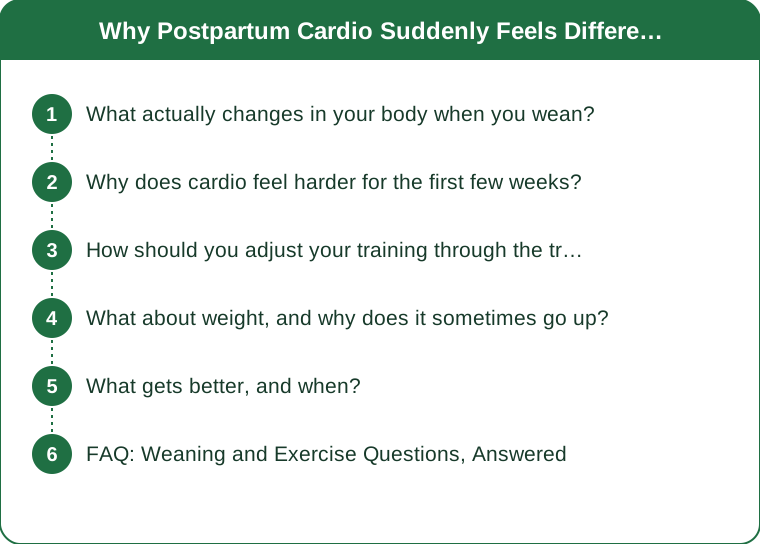
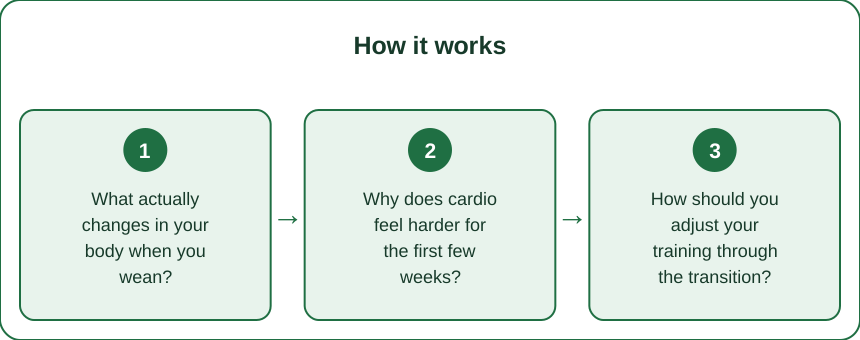
What actually changes in your body when you wean?
Several systems shift at once, which is why the effect feels bigger than any one item explains.
Prolactin falls and oestrogen rises. Prolactin has been suppressing oestrogen throughout lactation. As feeding stops, that suppression lifts. The transition period, typically two to six weeks, is when mood dips, sleep changes and general flatness are most commonly reported.
Your energy demand drops sharply. Exclusive breastfeeding costs roughly 400 to 500 calories a day. That requirement disappears over the weaning period, but appetite does not necessarily follow at the same rate.
Fluid balance changes. Milk production uses a significant volume of water daily. Many people notice they feel less thirsty and, initially, hold slightly more fluid.
Connective tissue firms up. Relaxin and the hormonal environment of pregnancy and lactation leave joints more mobile. As oestrogen returns to normal cycling, tissue stiffness gradually normalizes, which improves stability and can also mean your familiar stretches feel tighter.
Cycles usually return within one to three months, bringing back the monthly variation in energy and performance you had forgotten about.
Why does cardio feel harder for the first few weeks?
Four contributors, all temporary.
Mood and motivation dip. The prolactin-oestrogen shift is genuinely associated with low mood in the weeks around weaning. Perceived effort rises when mood is low, so the same pace feels harder without anything physiological changing in your legs.
Sleep changes. Weaning often disrupts night sleep for both of you in the short term, and prolactin has a mild sedative effect that is now gone. Poor sleep raises resting heart rate and reduces training tolerance measurably.
Fuelling gets misaligned. Some people keep eating at the lactation level and feel sluggish and heavy. Others, expecting to lose weight, cut back sharply at exactly the moment mood and sleep are already fragile, and underfuel their sessions.
Iron may be low. Postpartum iron deficiency is common and often undetected, and exercise tolerance is one of the first things it affects. If breathlessness and heavy legs are out of proportion to everything else, ask your doctor for a blood test rather than assuming it is hormones. This is general information, not medical advice.
The pattern most people describe is: two to four weeks of feeling worse, then a distinct improvement to better than the lactation months.
How should you adjust your training through the transition?
Reduce intensity, hold volume, and stop testing yourself for a month.
Keep frequency the same. This is the single most protective thing, because momentum is the hard thing to rebuild. Four sessions a week at 70 percent beats two at 100 percent.
Convert one hard session to easy. If you were doing two interval sessions, make one a steady conversational run or walk. Keep the other, but shorten it.
Use effort rather than pace or heart rate for a few weeks. Heart rate runs higher with disrupted sleep and hormonal change, so pace targets set in August will read as failures in October for reasons that have nothing to do with fitness.
Add strength if it is not already there. As joint laxity normalizes, this is actually a favourable window to build stability, and strength training supports mood in a way steady cardio does not always match.
Do not start a deficit in week one. Wait until mood, sleep and energy have stabilized, usually three to four weeks out, before changing anything about intake deliberately.

What about weight, and why does it sometimes go up?
This is the part that blindsides people, and it deserves a straight answer.
Some people gain a little at weaning. The energy demand drops by several hundred calories a day, and appetite regulation lags behind. If your intake stays where it was through lactation, a gradual gain is arithmetic, not failure.
Fluid shifts confuse the scale. Changes in hydration and the return of a menstrual cycle can move the number two to four pounds in either direction within days, with no relationship to body composition.
Some people lose, particularly those whose appetite was very high during feeding and drops noticeably afterwards.
The practical approach is unglamorous. Give it four weeks before you interpret anything, because the noise in the first month is larger than any real signal. Then, if you want to change composition, do it with a modest adjustment: slightly smaller portions of carbohydrate at two meals, protein kept high at around 1.6 grams per kilo of bodyweight, and strength training two to three times a week. Aggressive dieting during a hormonal transition with disrupted sleep is the reliable way to feel terrible and stall.
What gets better, and when?
It is worth knowing what you are waiting for, because the improvements are substantial.
Weeks 4 to 8. Mood generally stabilizes. Sleep improves as the night routine settles. Perceived effort at a given pace comes back down.
Weeks 6 to 12. Joint stability improves noticeably as tissue laxity normalizes. Many people report that running feels more solid and less wobbly than it has since before pregnancy, and that ankle and pelvic control improve without specific work.
Around month three. Cycles are typically established, which means you can start reading your own patterns again and planning harder sessions in the weeks you tolerate them best.
Fuelling becomes simpler. You are no longer trying to hit a moving calorie target while feeding, and eating around training gets far more straightforward.
And the practical one: you can train at any time of day without planning around feeds. For many people this single change does more for consistency than every physiological factor combined.
The honest summary is that the four weeks after weaning are the worst of the postpartum training year, and the four months after that are the best so far.
FAQ: Weaning and Exercise Questions, Answered
Will exercise affect my supply if I am weaning gradually?
Moderate exercise does not reduce milk supply, and this holds during a gradual wean as well. Very large sudden increases in training volume combined with significant underfuelling can affect supply, so the thing to watch is total energy intake rather than exercise itself. Comfort matters too: a supportive bra and feeding or expressing before a session makes higher-impact work far more tolerable during the tapering weeks.
Is the mood dip after weaning normal, and when should I get help?
A period of low or flat mood in the weeks around weaning is common and usually resolves within four to six weeks. It is not something to simply endure indefinitely, though. If low mood persists beyond six weeks, worsens, interferes with caring for your baby, or includes hopelessness or thoughts of harm, contact your doctor or health visitor promptly. Postpartum depression can begin or resurface at weaning and it responds well to treatment.
Should I wait until after weaning to start running again?
No. There is no physiological reason to delay a return to impact until weaning, and the usual return-to-running considerations, pelvic floor symptoms, adequate strength, typically 12 weeks minimum postpartum, apply regardless of feeding status. The practical adjustments are comfort-based: a well-fitted high-support bra, timing runs after a feed, and accepting that breast fullness affects comfort more than performance.
TL;DR:
- Weaning shifts prolactin and oestrogen, cuts daily energy demand by several hundred calories, and changes fluid balance and joint laxity all at once.
- Expect two to four weeks where cardio feels harder, driven mostly by mood, sleep and fuelling rather than lost fitness.
- Hold your training frequency, drop one hard session to easy, and use perceived effort rather than pace for a month.
- Wait four weeks before interpreting the scale or starting any deliberate deficit, and get iron checked if fatigue is out of proportion.
This transition is short and it resolves in a good direction. The months after weaning are typically the strongest of the postpartum year, with better joint stability, simpler fuelling and complete freedom over when you train. Ride out the first month with volume rather than intensity and you arrive there with your habit intact.
See It in Motion
Seen here: Maternity Capris with Side Pockets — shop it on bubblelime.com
Keep Reading
This article is for general informational and styling purposes only. Fit, sizing, and product availability may vary.