Should You Track Heart Rate During Postpartum Cardio? Here Is What It Actually Tells You

Quick Answer: Heart rate tracking postpartum is most useful as a pacing tool, not a strict limit — keeping steady-state cardio in a range where you can still hold a conversation (roughly moderate intensity) is a more practical postpartum guide than chasing a specific number, especially while your cardiovascular baseline is still recovering from pregnancy and birth.
You strap on a heart rate monitor because someone told you to ‘watch your heart rate’ postpartum, and then aren’t sure what number you’re actually watching for. The number matters less than what you do with it.

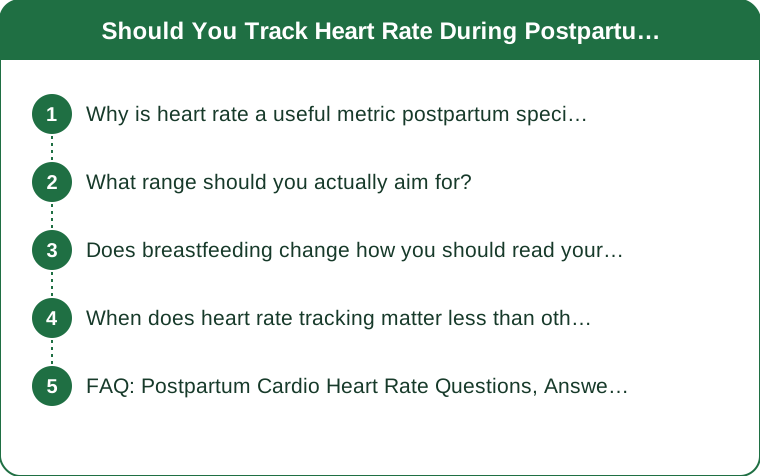
Why is heart rate a useful metric postpartum specifically?
Because your cardiovascular system genuinely changed during pregnancy — blood volume increased significantly, and it takes time postpartum for that to normalize, especially if you’re breastfeeding, which itself adds an ongoing metabolic and fluid demand.
A heart rate that used to correspond to ‘easy’ pre-pregnancy can feel and read differently in the early postpartum months, which is exactly why using a fixed pre-pregnancy target can be misleading.
What range should you actually aim for?
For most people returning to cardio postpartum, the talk-test remains more practical than a specific number: you should be able to speak in full sentences during steady-state cardio, which roughly corresponds to a moderate-intensity range. If you can’t complete a sentence without gasping, that’s a more reliable in-the-moment signal to ease off than any specific beats-per-minute number.
That said, checking that your heart rate isn’t spiking to a near-maximal range unintentionally during what should be a moderate session can catch overexertion you might not otherwise notice, especially in early postpartum weeks.

Does breastfeeding change how you should read your heart rate?
It doesn’t fundamentally change the exercise heart rate guidance, but it does affect recovery and hydration needs around exercise, which indirectly affects how your heart rate responds. Being under-hydrated or under-fueled from breastfeeding demands can make a given effort level feel and read as more taxing than the same session would pre-pregnancy.
This is a good reason to prioritize eating and drinking adequately around exercise sessions specifically, rather than a reason to avoid tracking heart rate altogether.
When does heart rate tracking matter less than other signals?
Certain postpartum-specific signals override a ‘fine’ heart rate reading entirely — any leaking, pelvic heaviness, or abdominal doming during cardio means scaling back regardless of what your heart rate shows. A heart rate in a reasonable range doesn’t mean the rest of your body is ready for that intensity.
Heart rate is one useful input among several, not the single deciding factor for postpartum cardio readiness.
FAQ: Postpartum Cardio Heart Rate Questions, Answered
Is there a hard heart rate limit I shouldn’t exceed postpartum?
Most current guidance has moved away from fixed numeric limits toward perceived exertion and the talk-test, since fitness level and individual recovery vary too much for one number to apply broadly.
Why does my heart rate seem higher than before pregnancy at the same effort?
This is common in early postpartum months due to still-normalizing blood volume and cardiovascular changes — it typically trends back toward your prior baseline over the following months with consistent, gradual activity.
Should I stop tracking heart rate if the numbers stress me out?
If tracking is adding anxiety rather than useful information, the talk-test alone is a completely valid substitute — the goal is pacing your effort, and there’s more than one reliable way to do that.
TL;DR:
- Heart rate postpartum is best used as a pacing tool, not a strict number to hit or avoid
- The talk-test (full sentences during steady-state cardio) is a practical, reliable complement
- Breastfeeding affects hydration and fueling needs, which indirectly affects how effort feels and reads
- Leaking, heaviness, or doming override a ‘fine’ heart rate reading — scale back regardless
This is general information, not medical advice — check with your provider on any specific concerns about postpartum cardiovascular recovery.
See It in Motion
Seen here: Maternity Capris with Side Pockets — shop it on bubblelime.com
Keep Reading
This article is for general informational and styling purposes only. Fit, sizing, and product availability may vary.