Why Your Core Feels Fine Until You Pick Up the Toddler

Quick Answer: Planks and walking train your core in predictable, symmetrical, slow-loading conditions. Lifting a toddler is asymmetric, unpredictable, fast, and often done from an awkward starting position while the load actively resists. Feeling fine in one and not the other usually means your deep core can hold a static brace but cannot yet produce or maintain pressure under a sudden off-center load. The fix is not more planks - it is loaded carries, offset work, and rehearsing the actual lift.
It is a deflating moment. Six months of feeling like you got yourself back, and then a doorway pickup at the end of a long day and there is that soft, unsupported feeling through the middle again. Nothing went wrong. You just found the edge of what your training covered.

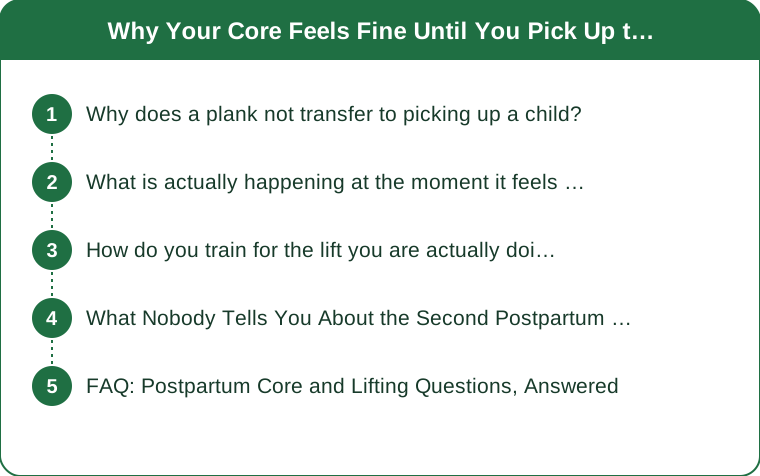
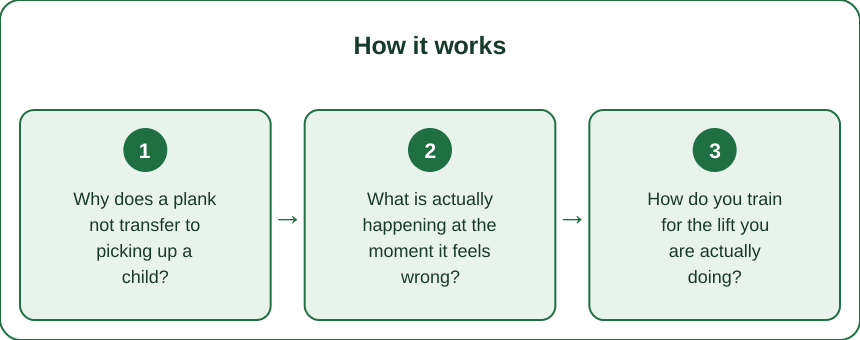
Why does a plank not transfer to picking up a child?
A plank is an isometric, symmetric, predictable task. You choose when to start, the load is your own body distributed evenly, and nothing changes for as long as you hold.
A toddler lift is none of those. Run through what actually happens:
- The load is off to one side, so your obliques and quadratus lumborum have to resist rotation and side-bending, not just flexion
- The load is live - it arches, twists, and goes suddenly heavy
- It starts from the floor, often from a half-kneel or a bent-over reach
- It happens fast, before you have consciously braced
- It repeats dozens of times a day, so fatigue accumulates
The specific capacity you need is intra-abdominal pressure management under a rapidly applied asymmetric load. Almost nothing in a standard postpartum core routine trains that. Dead bugs, bird dogs, and planks build the foundation, and they should not be skipped - but a foundation is not a transfer.
What is actually happening at the moment it feels wrong?
Usually one of three things, and they feel different from each other.
Pressure escapes. You take a breath, lift, and the pressure that should stabilize your spine instead pushes out or down. Signs: a visible bulge or doming along the midline, or downward pressure sensations in the pelvic floor. This is a coordination problem more often than a strength one - the diaphragm, deep abdominals, and pelvic floor are firing out of sequence.
The brace never arrives. You lift before your system engages. Common when you are tired, distracted, or grabbing a child who is walking away. Your spine takes the load in a slightly flexed and rotated position with no support, which is why it often shows up as low back soreness that evening rather than a core feeling.
Capacity runs out. The first ten lifts feel fine. The fortieth does not. This is genuine endurance, and it is the most common one in the second half of the first year, when the child gets heavier faster than your training progresses.
Where diastasis fits
If you have a gap that still lets pressure through, the load and the position are what matter, not the gap width. A midline that domes under load needs the load reduced and the breathing rebuilt before adding more. Persistent doming, leaking, heaviness, or pain is a pelvic floor physiotherapist conversation - that assessment is the fastest route to knowing which of the three problems you have. This is general information, not medical advice.

How do you train for the lift you are actually doing?
Train the pattern, not just the muscle. Four categories, and they can be done in fifteen minutes.
1. Loaded carries - the most underrated postpartum exercise
- Suitcase carry: one dumbbell or kettlebell in one hand, walk 20 to 30 metres staying upright. This is the toddler-on-the-hip position, trained deliberately.
- Front-loaded carry: weight held at the chest, walk. Trains the anterior brace under load.
- Start light. 6 to 8 kg is plenty to start, and the point is staying square, not the number.
2. Offset and anti-rotation work
- Half-kneeling press with one arm - this is the floor pickup position
- Pallof press with a band, holding against rotation
- Single-arm rows without letting the ribs twist
3. The lift itself, loaded
- Goblet squat to a low box, standing up with the weight held high on the chest
- Kettlebell deadlift from the floor - the exact hinge you use to collect a child
- Half-kneel to stand holding a weight, alternating lead legs
4. Breathing under load
Exhale as you lift. Not a held breath and not a collapse - a controlled exhale that starts a half second before the effort. It is the cheapest fix on this list and it changes how the lift feels immediately for a lot of people.
A workable weekly shape: two sessions, each with one carry, one offset movement, one loaded hinge or squat. Three sets, 6 to 10 reps, or 30 metres for carries. Progress by adding weight, not reps.
What Nobody Tells You About the Second Postpartum Year
The load goes up faster than you do. A newborn is 3.5 kg. At eighteen months, roughly 11 kg. At three years, 14 or more - and by then they are being lifted into car seats, out of baths, and off the floor mid-tantrum. Your training has to progress at least as fast as your child grows, and almost nobody’s does.
The awkward lifts are the ones that hurt. Not the clean pickup from the floor - the reach across the car seat, the extraction from the bath at full arm’s length, the lift from a shopping trolley. Those are long-lever loads at maximum disadvantage. If you are going to rehearse anything, rehearse those positions with a light weight, deliberately, when you are fresh.
Fatigue is a mechanical variable. On four hours of broken sleep, motor control genuinely degrades. The same lift at 9am and at 9pm are different lifts. Some of what feels like a setback is simply the end of a day.
One-sided habits compound. Most people carry on the same hip every single time. Over months that builds a real asymmetry. Alternate deliberately - it feels wrong on the non-dominant side, which is exactly the evidence that it needs doing.
It does not resolve on its own with time. This is the one worth hearing. Waiting another six months without changing the training usually produces another six months of the same thing. The capacity gap closes when it is trained.
FAQ: Postpartum Core and Lifting Questions, Answered
How long postpartum before I should expect this to feel normal?
There is no single timeline, and the honest answer is that it tracks training more than months. Tissue healing is largely done in the first several months; capacity for loaded, asymmetric lifting is built afterward and only if you build it. Plenty of people are two years out and still have the gap because nothing addressed it.
Is it safe to lift heavy if I still have a small gap?
Gap width matters less than whether the midline can generate tension. If you can load without doming, without leaking, and without pain, progressive loading is generally appropriate and is what builds the tissue. If any of those three appear, reduce the load and get assessed rather than pushing through.
Should I wear a support belt for daily lifting?
A belt can be useful short-term for confidence or specific heavy tasks, but relying on it all day means the system underneath is not being asked to do the job. Think of it as a tool for a specific lift, not a default setting.
My back hurts, not my abs. Is that still a core issue?
Often, yes. When the anterior system does not generate enough pressure, the spinal extensors take up the slack, and they announce it that evening. Back soreness after a day of lifting a child is one of the most common presentations of exactly this problem.
TL;DR:
- Planks are static and symmetric; toddler lifts are fast, off-center, and unpredictable. Feeling fine in one predicts nothing about the other.
- The three failure modes: pressure escapes, the brace arrives late, or endurance runs out by the fortieth lift of the day.
- Train loaded carries, offset half-kneeling work, and the loaded hinge - two short sessions a week beats more floor core work.
- Exhale into the lift, alternate the carrying hip, and rehearse the awkward positions when you are fresh.
The gap between how you feel walking and how you feel lifting is not a sign that recovery failed. It is a map of what has not been trained yet - and it is a very trainable list.
See It in Motion
Seen here: Maternity Capris with Side Pockets — shop it on bubblelime.com
Keep Reading
This article is for general informational and styling purposes only. Fit, sizing, and product availability may vary.