The First Twelve Weeks of Core Work After Birth, Week by Week

Quick Answer: Postpartum core work progresses through four stages: breathing and connection from around week one, gentle loading from weeks four to six, progressive loading from weeks eight to twelve, and return to full training after that. The gate between stages is not the calendar - it’s whether you can maintain the movement without doming, leaking, or heaviness. Most people move faster through stage one and slower through stage three than they expect.
The postpartum advice landscape is unhelpfully split between ‘rest and don’t do anything’ and a six-week clearance appointment after which you’re apparently fine.
What’s missing is the middle: an actual progression, with checkpoints that tell you when to move on. Here it is.
This is general information, not medical advice, and it does not replace a postnatal assessment. Everyone’s birth, recovery, and circumstances differ - caesarean recovery in particular follows a different timeline. If you have access to a pelvic health physiotherapist, that assessment is worth more than any article, including this one.

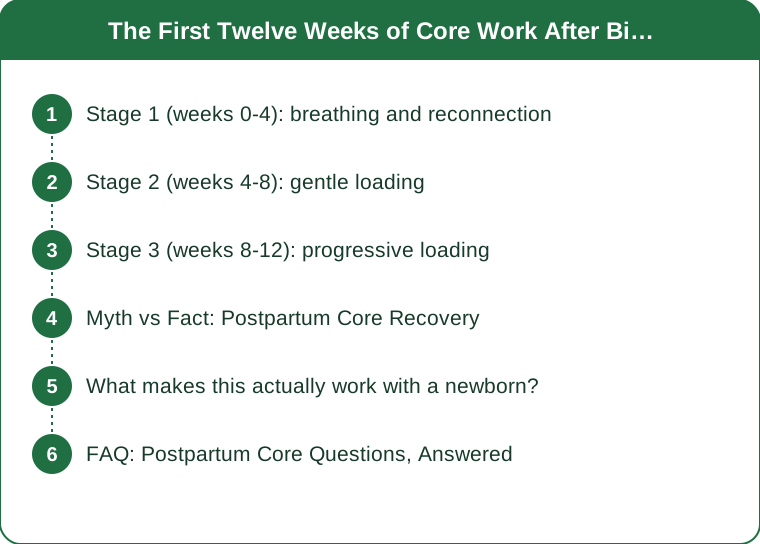
Stage 1 (weeks 0-4): breathing and reconnection
This stage looks like nothing and does more than it appears to.
What you’re doing: re-establishing the coordination between the diaphragm, the deep abdominal wall, and the pelvic floor. During pregnancy these were progressively stretched and their timing disrupted. The connection has to come back before any loading makes sense - loading a system that isn’t coordinating just reinforces the compensation.
The exercises, done lying down or side-lying:
1. Diaphragmatic breathing. Hands on the lower ribs. Breathe in and feel the ribs widen sideways; breathe out and feel them settle. 10 breaths, two or three times a day. This is the foundation of everything that follows.
2. Connection breath. On the exhale, add a gentle lift of the pelvic floor - the sensation of stopping wind, not a hard squeeze. Fully release on the inhale. The release matters as much as the lift. 10 repetitions, twice daily.
3. Gentle transverse activation. Exhale, connection breath, and feel the lower abdomen draw in slightly. Not a hard brace. Hold for a breath, release.
What to avoid entirely in this stage: sit-ups, crunches, planks, anything that lifts both legs, and lifting anything heavier than the baby where avoidable.
How you’ll know it’s working: the connection starts to feel automatic rather than something you have to concentrate to find. This usually takes two to four weeks of consistent short practice, and it’s the single highest-value thing in the whole progression.
Stage 2 (weeks 4-8): gentle loading
Only once the connection breath feels reliable. Caesarean recovery generally starts this stage later - typically after the six-week check and with clearance.
The three things to check before progressing:
- No doming or coning - a visible ridge or bulge down the midline when you exert
- No leaking with the movement
- No dragging or heaviness in the pelvis during or after
Any of those three means stay at the current stage. They aren’t signs of failure - they’re the feedback the system is giving you, and continuing past them is how people end up with problems that take much longer to resolve.
The exercises:
- Heel slides. On your back, knees bent, exhale and slide one heel away while keeping the low back position steady. 8 per side. Watch the midline the whole time.
- Glute bridges. Exhale and lift. 10 reps. Excellent, and safe early.
- Side-lying clamshells. 10 per side.
- Bird dog, opposite arm and leg, small range. 6 per side, slowly.
- Wall push-ups. 10 reps. Upper body strength matters enormously with a growing baby to carry.
- Supported squats to a chair. 10 reps.
Twice to three times a week, 15 minutes. Alongside walking, which is worth doing daily and building gradually.
On diastasis specifically: some separation of the abdominal wall is universal in late pregnancy and it narrows for most people in the months after. What matters more than the width of the gap is the tension you can generate across it - a narrow gap with no tension is a worse outcome than a wider one that generates tension well. Doming during a movement is the sign the load is currently too much.
Stage 3 (weeks 8-12): progressive loading
This is the stage people rush and the one where the outcome is largely determined.
Progress here only when stage 2 movements are comfortable, controlled, and produce none of the three warning signs.
The exercises:
- Dead bug. On your back, opposite arm and leg extending. 8 per side. Progress by extending further, not faster.
- Modified side plank from the knees. Hold 15-20 seconds, 3 per side.
- Single-leg glute bridge. 8 per side.
- Goblet squat with a light weight. 3 sets of 8.
- Suitcase carry - walking with a weight in one hand, resisting the lean. 30 seconds per side, 3 rounds. One of the best early postpartum core exercises there is, and rarely prescribed.
- Bent-over row with dumbbells. 3 sets of 8. Upper back strength directly counteracts the posture that feeding and carrying create.
Three sessions a week, around 25 minutes.
What still waits: running, jumping, heavy overhead lifting, full planks, and any direct abdominal flexion work like crunches or sit-ups.
On returning to running specifically - the most common question at this stage. The general guidance from pelvic health physiotherapy is that around three months is the earliest reasonable point, and only after passing a set of load tests: single-leg balance, single-leg squats, hopping, and jogging in place, all without leaking, pain, or heaviness. Returning to running before the system is ready is one of the most common causes of persistent pelvic floor problems, and the timeline is genuinely worth respecting even when you feel fine walking.

Myth vs Fact: Postpartum Core Recovery
Myth: The six-week check clears you for everything. Fact: It’s a brief medical check for infection, healing, and contraception - it’s usually not a musculoskeletal assessment at all, and in most systems it doesn’t include any examination of the pelvic floor or abdominal wall. Being told you’re ‘fine’ at six weeks means no medical concerns were found, not that your core is ready for load.
Myth: Crunches will close a diastasis. Fact: Repeated flexion under load often increases doming and can make things worse in the early stages. What builds tension across the midline is deep abdominal work with proper breathing coordination, progressed gradually. Flexion work has a place later, not first.
Myth: If you didn’t do this work in the first year, you missed the window. Fact: There’s no closing window. Pelvic floor and abdominal function improve with appropriate training at any point postpartum, including years later. People make substantial progress starting at five years post-birth, and it’s one of the most common presentations pelvic health physios see.
Myth: A caesarean means you don’t need pelvic floor work. Fact: Pregnancy itself loads the pelvic floor for nine months regardless of delivery mode. Caesarean recovery adds abdominal wall healing on top, which is why the timeline is generally more conservative rather than less.
Myth: Leaking a bit is just what happens after kids. Fact: It’s common and it’s not something you have to accept. Pelvic floor training resolves or substantially improves stress incontinence for the large majority of women who do it properly, and a physio assessment is the fastest route to knowing what ‘properly’ means for you.
What makes this actually work with a newborn?
The plan is straightforward. Doing it with a baby in the house is the hard part.
Attach it to something that already happens. The connection breath during a feed. Glute bridges while the baby is on the floor mat. Ten minutes attached to an existing routine beats a planned thirty-minute session that never happens.
Split it up. Three five-minute blocks across a day is as effective as fifteen minutes together, and dramatically more achievable.
Lower the bar for what counts. Two exercises done is infinitely better than a full session skipped. The consistency is the active ingredient, not the completeness of any individual session.
Expect setbacks around sleep regressions and illness. Recovery is not linear, and a week where nothing happens is normal rather than a failure. Pick it up where you left off rather than starting again.
Get assessed if you possibly can. A pelvic health physiotherapist can tell you in one appointment what an article can’t: what your specific pelvic floor and abdominal wall are actually doing, and which stage you should be at. In some countries this is routine postnatal care; in others you have to ask for it or fund it. It’s worth asking for either way.
Signs to seek assessment sooner rather than later: any leaking, a sensation of heaviness or dragging in the pelvis, pain with intercourse, back or pelvic pain that isn’t improving, or doming that doesn’t reduce as you progress. None of these are things to wait out.
FAQ: Postpartum Core Questions, Answered
How do I know if I have diastasis recti?
Lie on your back, knees bent, lift your head slightly and feel along the midline above and below the navel. A gap you can sink fingers into is separation. But the more useful question is whether you can generate tension there - a gap that firms up under the fingers when you exhale and engage is functioning better than a narrow one that stays soft.
Can I do this while breastfeeding?
Yes. Relaxin and hormonal changes persist for a while postpartum and joints can feel less stable, which is a reason to progress gradually rather than to avoid training. Exercise doesn’t reduce milk supply; underfuelling and dehydration can, so eat and drink accordingly.
What if I’m six months or two years postpartum and never did any of this?
Start at stage 1 anyway. It takes a couple of weeks and it establishes the coordination everything else depends on. You’ll likely move through stages 1 and 2 faster than someone at four weeks post-birth, but skipping them tends to produce the same compensations regardless of how much time has passed.
Is it normal for this to feel emotional?
Common, yes - reconnecting with a body that’s changed significantly brings up a lot for many people, and the postpartum period is emotionally loaded regardless. If low mood or anxiety is persistent rather than passing, that’s worth raising with your health visitor or doctor as its own thing.
TL;DR:
- Four stages: breathing and connection, gentle loading, progressive loading, return to full training
- The gate between stages is doming, leaking, or heaviness - not the calendar
- Stage 1 is breathing work and it’s the foundation everything else sits on
- Avoid crunches, planks, and running until the earlier stages are genuinely solid
- Running generally waits until around three months and until you pass load tests
- Attach it to existing routines and split it into five-minute blocks - consistency is the active ingredient
The six-week check clears you medically, not mechanically. The progression is what fills the gap, and there’s no window that closes.
See It in Motion
Seen here: Maternity Capris with Side Pockets — shop it on bubblelime.com
Keep Reading
This article is for general informational and styling purposes only. Fit, sizing, and product availability may vary.