How to Check for Diastasis Recti at Home (And What to Do Next)

Quick Answer: A basic diastasis recti self-check involves lying on your back, lifting your head slightly while feeling along your midline above and below your belly button for a gap and its depth — but a self-check is a starting point, not a diagnosis, and a pelvic floor physical therapist gives a far more reliable assessment.
Before restarting core work after pregnancy, checking for diastasis recti (abdominal muscle separation) tells you what kind of approach your body actually needs — and doing certain exercises before checking can make an existing separation worse.

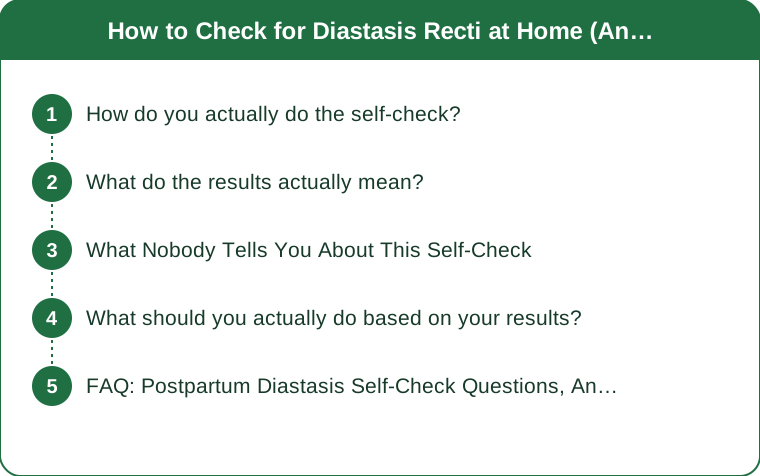
How do you actually do the self-check?
Lie on your back with knees bent, feet flat. Place two fingers just above your belly button, then gently lift your head and shoulders slightly off the ground (a small crunch-like motion) while feeling for a gap between the left and right sides of your abdominal muscles.
Repeat at your belly button and just below it, since separation can vary along the length of the muscle — note both the width of the gap (in finger-widths) and whether the tissue feels firm or soft when you press down.
What do the results actually mean?
A gap of 1-2 finger-widths is common and often considered within a functional range for many postpartum bodies, while a gap of 3+ finger-widths, or tissue that feels very soft with visible doming/bulging during the lift, suggests more significant separation worth professional evaluation.
Depth and tissue tension matter as much as width — a narrow but very soft, doming gap can be more functionally significant than a slightly wider but firm one.

What Nobody Tells You About This Self-Check
Timing matters — checking too early postpartum (before 6-8 weeks) can give an inaccurate picture since normal healing is still underway; most guidance recommends waiting until at least this point for a meaningful check.
Also underrated: self-checks have real limits — a pelvic floor physical therapist can assess with far more precision, including checking for related pelvic floor dysfunction that often accompanies diastasis but isn’t detectable through a self-check alone.
What should you actually do based on your results?
If your gap is within a functional range and tissue feels firm, gentle core reconnection work (deep breathing, pelvic tilts, transverse abdominis activation) is generally a safe starting point before progressing to more demanding core exercises.
If you find a significant gap, doming, or soft tissue, avoid traditional crunches, planks, and heavy lifting until you’ve been evaluated by a pelvic floor physical therapist, since these can worsen separation in some cases before the tissue has appropriately healed.
FAQ: Postpartum Diastasis Self-Check Questions, Answered
When is the earliest I should check for diastasis recti postpartum?
Most guidance suggests waiting until at least 6-8 weeks postpartum, once initial healing is underway, for a more accurate self-check.
Can diastasis recti heal on its own without specific exercises?
Some narrowing happens naturally in many people, but significant separation often benefits from targeted rehabilitation rather than time alone.
Is it safe to do core exercises with diastasis recti?
Gentle, targeted core reconnection work is generally appropriate, but traditional crunches and planks are typically discouraged until a professional confirms it’s safe for your specific case. This is general information, not medical advice.
TL;DR:
- Check along your midline above, at, and below the belly button while lifting slightly
- A 1-2 finger-width gap with firm tissue is often within a functional range
- Wait until at least 6-8 weeks postpartum for a more accurate self-check
- A pelvic floor physical therapist gives a far more precise assessment than self-checking alone
This is general information, not medical advice — a professional evaluation is the reliable next step before resuming demanding core work.
See It in Motion
Seen here: Maternity Capris with Side Pockets — shop it on bubblelime.com
Keep Reading
This article is for general informational and styling purposes only. Fit, sizing, and product availability may vary.