Are You Ready to Run After Baby? The Readiness Checks

Quick Answer: The commonly cited six-week clearance is a clearance for daily activity, not for running. Physiotherapy guidance generally puts a return to impact at around 12 weeks postpartum at the earliest, and only after you can pass a set of load tests - walking 30 minutes comfortably, single-leg balance, hopping, and single-leg squats - without leaking, heaviness, or pain.
The six-week appointment is short, busy, and mostly about healing rather than performance. Almost nobody is actually assessed for running readiness at it, which is why so many people return to impact on a date rather than on evidence.

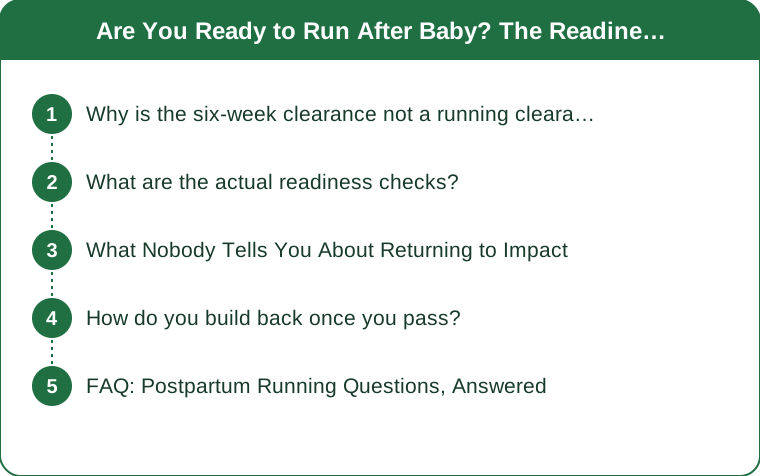
Why is the six-week clearance not a running clearance?
Because it is checking different things. The postnatal visit typically confirms that bleeding has resolved, incisions or tears are healing, and there are no signs of infection or serious complication. Those are important and they are not a test of whether your pelvic floor and abdominal wall can handle two to three times body weight landing on one leg, roughly 160 times a minute, for thirty minutes.
Tissue timelines make the gap clearer. Connective tissue remodeling continues for months. Relaxin and the hormonal changes of pregnancy affect ligament laxity well past delivery, and for people who are breastfeeding, lower estrogen levels can affect tissue quality for longer still. A cesarean birth is abdominal surgery with its own healing course, and a significant tear or an assisted delivery adds more.
The practical result is that the calendar tells you very little about any individual. Two people at 12 weeks can be in completely different places, and the only way to tell which is which is to test.
None of this means running is dangerous or off the table. It means the entry criterion should be a set of capabilities rather than a date on the calendar.
What are the actual readiness checks?
These are drawn from the return-to-running framework physiotherapists commonly use. Do them in order, and stop at the first one that produces symptoms.
Walk 30 minutes at a brisk pace with no leaking, no heaviness or dragging sensation in the pelvis, and no pain. This is the entry gate - if a walk produces symptoms, impact will produce more.
Single-leg balance, 10 seconds each side, then with eyes closed.
Single-leg calf raises, 20 reps each side, with good control at the top.
Single-leg bridge, 20 reps each side.
Single-leg sit-to-stand, 20 reps each side from a normal chair.
Hop in place, 10 reps each leg, then jog in place for 60 seconds, then forward bounds, 10 each leg.
The pass condition for every one of them is the same: no urinary or fecal leaking, no vaginal heaviness or bulging, no pain, and no doming or coning of the abdomen. Any of those means not yet - not never, just not yet, and usually with a specific thing to work on.
If you cannot pass the strength items, that is the training program. Build them, retest in a few weeks.

What Nobody Tells You About Returning to Impact
Leaking is common and is not something you have to accept. A large share of postpartum runners experience some urinary leaking, and its frequency is exactly why it gets treated as normal. Common is not the same as normal, and it is highly treatable with pelvic floor physiotherapy. Continuing to run through it does not train it away.
Heaviness is the symptom to take most seriously. A dragging or bulging sensation in the vagina, particularly later in the day or during exercise, can indicate pelvic organ prolapse and warrants an assessment before adding impact.
Abdominal separation is about function, not gap width. The useful question is not how many fingers fit but whether you can generate tension across the midline - whether the tissue stays flat rather than doming under load.
Sleep deprivation changes your tissue tolerance. Recovery capacity with a newborn is genuinely reduced, and a program that would be reasonable otherwise can be too much. This is a real physiological factor, not an excuse.
Breastfeeding affects the timeline. Lower estrogen can mean less tissue elasticity and, for some people, more discomfort with impact. It does not prevent running - it does mean building more slowly and getting well-fitted support.
A run-walk return is the standard, not a compromise. Nearly everyone who returns well returns by alternating - starting at something like 1 minute of running to 2 minutes of walking, and building over weeks.
How do you build back once you pass?
Slowly, and with strength work running alongside rather than after.
Weeks 1-2 back: run-walk intervals, 20 minutes total, three times a week. Something like 1 minute run, 2 minutes walk. If any symptom appears, stop the session and drop back the following week.
Weeks 3-6: extend the run intervals before extending total time. 2 minutes run to 1 minute walk, then 3 to 1, still capped around 25-30 minutes.
Weeks 7-12: continuous running, adding no more than about 10% of weekly volume at a time, keeping one full rest day between runs.
Alongside all of it, twice a week of strength work focused on the hip, glute, calf, and trunk - single-leg work in particular, because running is a single-leg activity and most postpartum weakness shows up there first.
And keep testing. If a symptom appears at any stage, the answer is to step back one level and rebuild rather than to push through. Symptoms during a return are information, not failure.
This is general information, not medical advice. A pelvic health physiotherapist assessment is the single most useful thing most people can do before returning to impact - it is standard care in several countries and worth seeking out where it is not.
FAQ: Postpartum Running Questions, Answered
Is 12 weeks a hard rule?
No - it is a reasonable earliest point for most people, not a target. Some are ready later, and readiness is defined by passing the load tests rather than by reaching a date. A cesarean birth, a significant tear, or ongoing symptoms all push the timeline out.
What if I already went back and I am leaking?
Stop the impact for now and get a pelvic health physiotherapy assessment. Leaking that has already started does not resolve by continuing, and it responds well to targeted treatment. Walking and strength work can continue in the meantime for almost everyone.
Can I do anything before 12 weeks?
Yes, and you should. Walking, breathing and pelvic floor work, and progressive strength training are all appropriate well before impact and are exactly what makes the eventual return go smoothly. The restriction is on impact specifically, not on training.
TL;DR:
- The six-week clearance covers healing, not readiness for two to three times body weight of impact.
- Around 12 weeks is the earliest reasonable point, and only after passing walking, balance, strength, and hopping tests.
- Any leaking, heaviness, pain, or abdominal doming means not yet - and usually points to a specific thing to train.
- Return with run-walk intervals and keep strength work running alongside, not afterward.
The calendar cannot see your pelvic floor. Run the checks, work on whatever they surface, and the return happens on evidence instead of on a date somebody else picked.
See It in Motion
Seen here: Maternity Capris with Side Pockets — shop it on bubblelime.com
Keep Reading
This article is for general informational and styling purposes only. Fit, sizing, and product availability may vary.