The Postpartum Return to Running Checks Nobody Runs Through First

Quick Answer: Most guidance suggests returning to running no earlier than 12 weeks postpartum, and only once you can pass a set of load tests symptom-free - walking 30 minutes, single-leg balance, single-leg squats, hopping, and running in place - with no leaking, no heaviness, and no pain. Time since birth is a minimum, not a green light. A pelvic health physiotherapist assessment is the single best thing you can do first.
The six-week check tends to get treated as clearance for everything, and it is not designed to be. It is a brief postnatal review, usually without any assessment of pelvic floor function under load - and running is the most demanding load most people will put through that system.

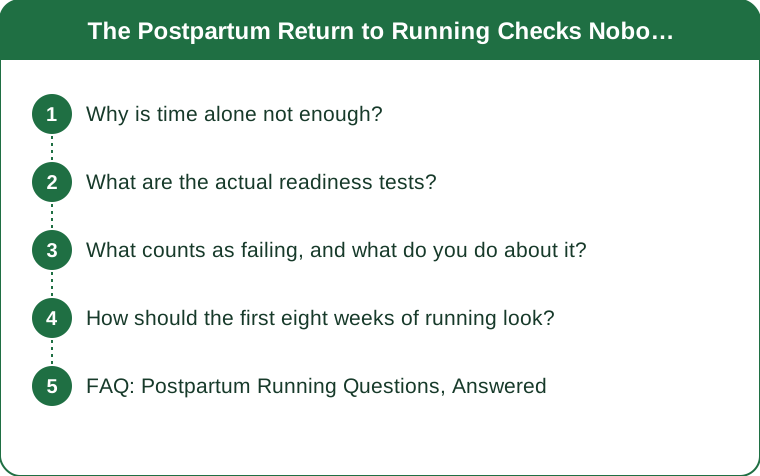
Why is time alone not enough?
Running produces ground reaction forces of roughly two to three times bodyweight, repeated a few thousand times per session. The tissues that have to manage that - pelvic floor, abdominal wall, and the connective tissue between them - have spent nine months adapting to pregnancy and then, in most cases, a birth.
Healing timelines vary enormously. Connective tissue remodelling continues for months. Breastfeeding maintains lower oestrogen levels, which affects tissue properties. A caesarean is major abdominal surgery. A significant perineal tear has its own recovery arc. Sleep deprivation reduces tissue repair capacity across the board.
Influential postnatal running guidance published in 2019 by Goom, Donnelly and Brockwell recommends a minimum of three months before a return to running, alongside a set of functional tests - and explicitly frames time as necessary but not sufficient.
The practical translation is simple: the clock tells you when you may start testing, and the tests tell you when you may start running. Someone at four months who passes everything is more ready than someone at ten months who leaks on the third hop.
This is general information, not medical advice.
What are the actual readiness tests?
These are the load tests commonly used in postnatal running guidance. Every one must be completed with no leaking, no dragging or heaviness in the pelvis, no pain, and no doming of the abdomen.
Endurance and impact progression:
- Walk 30 minutes briskly
- Single-leg balance, 10 seconds each side
- Single-leg squat, 10 repetitions each side
- Jog in place, 1 minute
- Forward bounds, 10 repetitions
- Hop in place, 10 repetitions each leg
- Single-leg running-man movement, 10 each side
Strength benchmarks, tested separately:
- Single-leg calf raise, 20 repetitions
- Single-leg bridge, 20 repetitions
- Single-leg sit-to-stand, 20 repetitions
- Side-lying hip abduction, 20 repetitions
That strength list is the part people skip, and it is where most people fail. Twenty single-leg sit-to-stands is a genuine test of hip and quad capacity, and running without it means the pelvic floor absorbs load that stronger legs should be managing.
Run the tests on a day you are reasonably rested, not at 6pm after a bad night. Symptoms are considerably more likely when you are exhausted, which is useful information in itself.

What counts as failing, and what do you do about it?
Stop and seek assessment if you experience any of these, during the tests or during early running:
- Leaking urine or stool, even a small amount
- A feeling of heaviness, dragging, or bulging in the vagina
- Pelvic, back, or abdominal pain
- Visible doming or coning along the midline of the abdomen
- Ongoing bleeding that increases with activity
None of these mean you will never run. They mean the current load exceeds current capacity, which is a solvable problem in the large majority of cases.
The pathway is almost always the same: see a pelvic health physiotherapist, get an internal assessment if you are comfortable with one, and follow a targeted programme. Pelvic floor muscle training has strong evidence behind it for postnatal urinary incontinence, and generic instructions to do some pelvic floor exercises are far less effective than a programme built around what an assessment actually finds - because a pelvic floor that is overactive needs almost the opposite of one that is weak.
Leaking is common and it is not something to accept as permanent. Somewhere around a third of women experience urinary incontinence postnatally. Common does not mean untreatable, and the treatment success rates are good.
How should the first eight weeks of running look?
Assuming you pass the tests, start far below what you think you can do. The tests confirm you can tolerate the movement; they say nothing about volume.
Weeks 1 to 2: walk-run intervals. 1 minute running, 2 minutes walking, 20 minutes total, twice a week. On soft surfaces if available.
Weeks 3 to 4: 2 minutes running, 1 minute walking, 20 to 25 minutes, twice a week.
Weeks 5 to 6: 4 minutes running, 1 minute walking, up to 30 minutes, two or three times a week.
Weeks 7 to 8: continuous running, 20 to 30 minutes, building slowly.
Throughout, keep the strength work going. Two sessions a week of single-leg work, hip strength, and calf raises does more to protect you than any amount of careful pacing.
Some practical notes: a supportive, well-fitted sports bra matters more than usual, especially while breastfeeding. Empty your bladder before you go but do not habitually go just in case, which trains urgency. And check symptoms the day after, not just during - some issues only announce themselves later.
Any symptom from the failing list means step back a stage, not push through. Running with pelvic floor symptoms does not build tolerance; it accumulates load on a system already telling you it is at capacity.
FAQ: Postpartum Running Questions, Answered
How soon after birth can I start running?
Current guidance suggests no earlier than 12 weeks, and then only after passing load and strength tests without symptoms. A caesarean or a significant tear may need longer.
Is it normal to leak a little when running postpartum?
It is common, and it is not something you have to live with. It is a signal that load exceeds capacity right now. See a pelvic health physiotherapist - treatment outcomes for postnatal incontinence are generally good.
Do I need to see a pelvic health physio before running?
It is the single most useful step available, and in some countries it is standard postnatal care. If you have any symptoms at all, it moves from useful to necessary. This is general information, not medical advice.
TL;DR:
- Twelve weeks is a minimum, not clearance - the load tests decide readiness.
- Pass the walk, balance, squat, hop, and bound tests with no leaking, heaviness, doming, or pain.
- The strength benchmarks - 20 single-leg calf raises, bridges, and sit-to-stands - are where most people actually fail.
- Any symptom means step back and get assessed, not push through.
A structured return takes about eight weeks longer than an impatient one and is far more likely to end with you running comfortably a year from now. The tests take twenty minutes and are worth every one of them.
See It in Motion
Seen here: Maternity Capris with Side Pockets — shop it on bubblelime.com
Keep Reading
This article is for general informational and styling purposes only. Fit, sizing, and product availability may vary.