A Realistic Postpartum Fitness Plan for New Moms

Quick Answer: Wait for medical clearance — usually around 6 weeks, longer after a C-section — then start with walking and breath-based core work. Build with short bursts that fit real life: a 10-minute pram walk, a few core moves at nap time. Stop and see a pelvic-floor physio if you notice leaking, heaviness, doming or pain.
Every postpartum plan on the internet assumes an uninterrupted hour and a body that slept.
You have neither. That’s not a scheduling problem to solve — it’s the actual conditions, and a plan that ignores them fails in week two.
So here’s one built for the conditions you’re in.

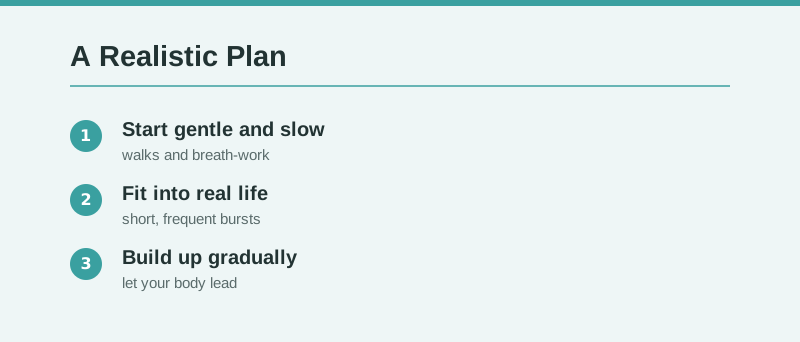
When can you start exercising after having a baby?
After you’ve been cleared by your doctor or midwife — commonly around the six-week check, and meaningfully longer after a caesarean or a complicated delivery.
Then start gentler than feels satisfying:
- Easy walking. Ten minutes with the pram. Build by about five minutes a week if it feels fine the next day.
- Breath-based core work. Not crunches. Exhale as you gently draw the lower belly in and lift the pelvic floor, then fully release. 2 sets of 8 breaths. This is the foundation everything else gets built on, and it’s the step people skip.
- Gentle mobility. Neck, chest and hip openers — an honest counterweight to hours of feeding posture.
There’s genuinely no rush. Pushing too hard too soon can set recovery back by months, which is the slowest possible route to where you want to be.
How do you fit workouts around a newborn?
You don’t. You break the workout into pieces small enough to survive the day.
Short and frequent genuinely adds up: three separate 10-minute walks equal a 30-minute walk in almost every way that matters. A few core moves at nap time. Stretching on the floor while the baby has tummy time and judges your form.
A workable week looks like: walking most days, two short strength sessions of 10–15 minutes, mobility whenever the floor is already involved.
Realistic postpartum fitness works with unpredictable days rather than requiring them to change. Little and often isn’t the compromise version — in this season it’s the whole strategy.

How do you progress without overdoing it?
Follow the next-day rule: if you feel fine the day after, that dose was right. If you’re wiped out or sore in your pelvic floor, it was too much — go back a step for a week.
A rough shape, with the caveat that individual timelines vary enormously:
- Weeks 6–10: walking, breath work, bodyweight movements — sit-to-stands, wall push-ups, glute bridges.
- Weeks 10–16: add light resistance. Bands, light dumbbells, 2 sets of 10.
- Month 4 onward: gradually add load and, if you want it, a slow return to impact — assuming everything below is clear.
Some weeks you’ll progress. Others, between broken sleep and growth spurts, you’ll hold steady. Holding steady is not backsliding, and a plan that can’t absorb a bad fortnight isn’t a plan.
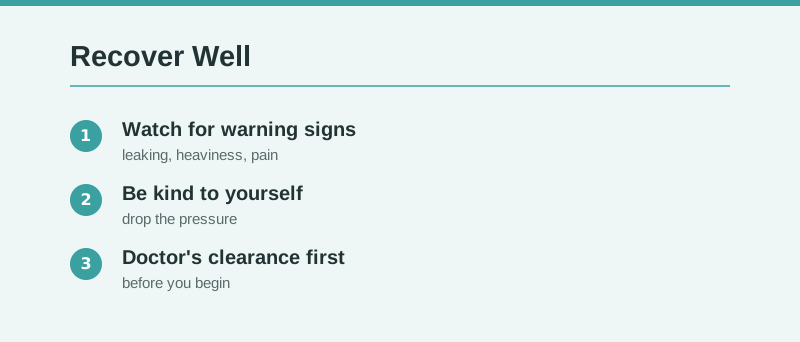
What warning signs mean you should stop?
These are the ones that matter, and they’re information rather than failure:
- Leaking urine during or after movement
- A feeling of heaviness, dragging or bulging in the pelvic area
- Doming or coning down the midline of your abdomen during effort
- Pain anywhere — pelvic, back, or at a scar
- Bleeding that returns or increases after it had settled
Any of these means scale back and book a pelvic-floor physiotherapist. In much of the world that’s routine postpartum care; where it isn’t, it’s worth seeking out anyway and it’s the highest-value appointment available to you right now.
Also worth flagging to your doctor: persistent low mood, anxiety, or intrusive thoughts. Common, treatable, and not a matter of willpower.
This article is general information, not medical advice — your provider knows your delivery and your history.
FAQ
When can I run again after having a baby?
Most guidance suggests waiting at least 12 weeks and, ideally, getting a pelvic-floor assessment first. Impact loads a pelvic floor that’s still recovering, and returning too early is a common route to problems that take much longer to fix.
Can I do crunches or planks postpartum?
Not early on, and not until you’ve checked for diastasis recti. Start with breath-based core work and progress under guidance — traditional ab exercises can worsen a separation if the deep system isn’t working yet.
Do I need to wait for my six-week check to start walking?
Usually not — gentle short walks are commonly encouraged well before it, and moving a little each day helps circulation and mood. It’s the structured exercise, loading and impact that wait for clearance, so ask specifically at your appointment rather than assuming one answer covers everything.
How long until I feel like myself again?
Most people describe something like normal returning somewhere between 6 and 12 months, with sleep as the main variable. Muscle rebuilds noticeably faster the second time around, so nothing you built before this is lost.
TL;DR:
- Get cleared first — around 6 weeks, longer after a C-section.
- Start with walking and breath-based core work, not crunches.
- Short bursts count: three 10-minute walks equal one 30-minute walk.
- Use the next-day rule to progress; holding steady during hard weeks is normal.
- Leaking, heaviness, doming, pain or returning bleeding → scale back and see a pelvic-floor physio.
Forget bouncing back. Rebuild steadily, in ten-minute pieces, at the pace your actual life allows — and be as patient with yourself as you’d be with a friend in the same week.
See It in Motion
Seen here: Maternity Capris with Side Pockets — shop it on bubblelime.com
Keep Reading
This article is for general informational and styling purposes only. Fit, sizing, and product availability may vary.