Why a Heavier Baby Changes Your Training More Than the Birth Did

Quick Answer: Between birth and around month eight, the weight you carry every single day roughly doubles — and unlike a gym programme, it never deloads. That progressive daily load is what produces the mid-year wave of back, wrist and pelvic floor symptoms that people wrongly attribute to the birth itself. The fix is to train carries and single-arm work deliberately, and to change sides consciously rather than defaulting to your strong hip.
Most postpartum advice is organised around the birth: the first six weeks, the return to exercise, the clearance appointment. All of it looks backwards at an event. Meanwhile the thing actually loading your body is in front of you and getting heavier every week, and nobody writes a programme for it.
This is general information, not medical advice.

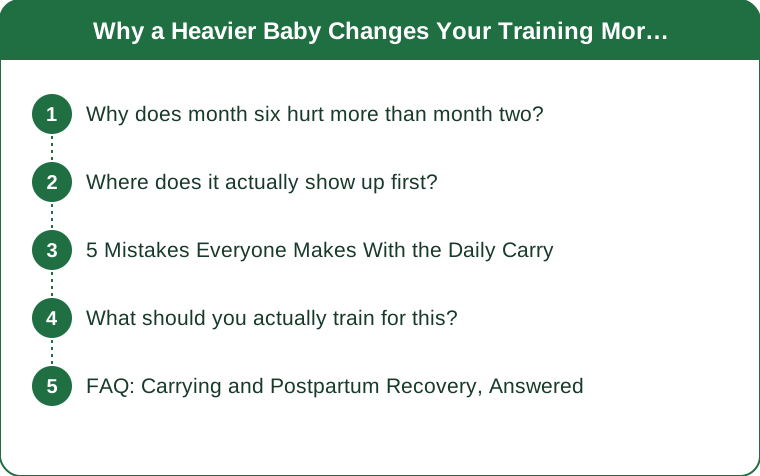
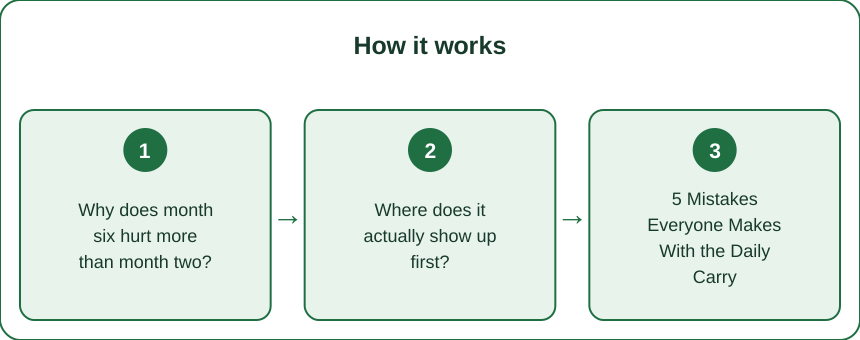
Why does month six hurt more than month two?
Because the load has doubled and the rest has not improved.
A newborn is commonly around three to three and a half kilos. By six months a typical baby is around seven to eight, and by a year often nine or ten. That is a progressive overload programme run continuously, seven days a week, with no planned recovery and no deload — which is exactly the pattern that produces overuse injury in athletes.
And the carry is never symmetrical. Almost everyone has a dominant hip. You carry on it, you cook with the other hand, you pick up from the cot on the same side every time. So one side of your body is doing the loaded work and the other is stabilising, day after day, at a weight that keeps rising.
This is why the symptom wave arrives in the middle of the first year rather than at the start. It is not that your recovery has stalled. It is that the external load finally exceeded what the system was conditioned for, and it did so quietly.
Where does it actually show up first?
Four places, in a fairly predictable order.
The wrist and thumb. Repeatedly lifting a baby under the arms with the thumb abducted is the classic mechanism for de Quervain’s tenosynovitis — so common postpartum it is nicknamed mum’s thumb. It usually shows up between months two and six, and it gets worse exactly as the baby gets heavier. The fix is mostly technique: scoop from underneath with a flat hand and a neutral wrist rather than gripping under the armpits with your thumbs doing the work.
The upper back and neck. Long holds with the baby on one hip mean sustained side-bending and a shoulder that lives in elevation. The ache sits between the shoulder blade and the spine and is worse in the evening.
The low back and SI joint. Hip-carrying shifts your centre of mass sideways and you compensate by pushing the opposite hip out. Held for months, this is a reliable way to irritate the sacroiliac joint, which is already more mobile postpartum.
And the pelvic floor. Carrying increases intra-abdominal pressure continuously rather than in spikes. A floor that handles a single heavy lift fine can struggle with twenty minutes of walking around a supermarket with a nine kilo toddler on one arm, which is why some people find symptoms return late in the first year having thought they were finished.

5 Mistakes Everyone Makes With the Daily Carry
1. Always using the same hip. Almost universal and almost entirely unconscious. Set a rule that gives you a reason to switch — change sides every time you go through a doorway, or at every set of stairs. Arbitrary triggers work better than good intentions.
2. Lifting with the thumbs. Hands under the armpits with thumbs hooked is the single biggest contributor to wrist pain. Slide a flat hand under the bottom and support the back with the forearm instead. It takes a week to feel normal.
3. Training the gym version and not the real version. Bilateral squats and crunches do very little for a load that is single-sided, held at hip height, and wriggling. Train carries and single-arm work if you want it to transfer.
4. Holding your breath on every lift. Cot rails and car seats are the two lifts that produce the most breath-holding, and breath-holding drives pressure down into the pelvic floor. Exhale as you lift. Out loud if it helps you remember.
5. Never putting the baby down. The carry is the load, and load without rest is the whole problem. A floor mat, a play gym, a sling that distributes weight across both shoulders — anything that breaks up a two-hour continuous hold is worth more than any exercise you could do that day.
What should you actually train for this?
Four movements cover nearly all of it, and none of them need a gym.
Suitcase carries. Hold one weight — a kettlebell, a shopping bag, a water container — at your side and walk, resisting the urge to lean. Thirty to forty seconds per side, two or three rounds. This is the closest direct match to what you do all day and it trains the lateral trunk to stop you collapsing onto the loaded hip.
Single-arm rows. Anything you can pull towards your ribs with one arm, supported on a chair. This builds the mid-back capacity that stops the shoulder-blade ache.
Split squats. Because you almost never stand up from the floor with a baby using both legs evenly. Two sets of six to eight per side, holding a counter if needed.
Loaded step-ups or stairs. Carrying a weight up a flight of stairs is the exact task that hurts, and it is trainable. Start with the baby’s weight and progress slowly.
Two sessions a week of those four, fifteen to twenty minutes each, does more for how your body feels at month eight than any amount of core work. Progress the weight roughly as the baby grows — that is the whole principle, and it is the one nobody states out loud.
FAQ: Carrying and Postpartum Recovery, Answered
Is carrying my baby on one hip actually bad for me?
Not in itself — the body handles asymmetric load perfectly well. The problem is exclusivity and duration. Alternating sides and breaking up long holds removes most of the risk, without you having to change anything about how you parent.
My wrist pain is getting worse even though I changed my technique. What now?
See a GP or a hand physiotherapist rather than waiting it out. De Quervain’s responds very well to early treatment — a splint, activity modification, sometimes an injection — and much less well once it has been running for six months.
I thought I was past pelvic floor symptoms and they came back at month nine. Why?
This is common and it is usually load, not regression. The daily carry weight has roughly tripled since birth while the floor has been progressing at its own pace. A pelvic health physiotherapist can tell you in one appointment whether it is a strength issue, a coordination issue, or simply too much continuous load.
TL;DR:
- Your daily carry load doubles in the first year with no deload, which is why symptoms peak mid-year rather than right after birth.
- Wrist and thumb pain is usually a technique problem: scoop from underneath, keep the wrist neutral, stop gripping with the thumbs.
- Alternate hips on an arbitrary trigger — doorways, stairs — because good intentions do not survive a tired afternoon.
- Train suitcase carries, single-arm rows, split squats and loaded stairs, and add weight as the baby grows.
The birth is the event everyone plans around. The carry is the training programme you are actually on, and it is the one that decides how your back and wrists feel at the end of the first year. Train for it on purpose and the mid-year symptom wave mostly does not arrive.
See It in Motion
Seen here: Maternity Capris with Side Pockets — shop it on bubblelime.com
Keep Reading
This article is for general informational and styling purposes only. Fit, sizing, and product availability may vary.