Why Does One Cold Wreck Weeks of Postpartum Core Progress — And How Do You Rebuild Without Starting Over?

Quick Answer: A short illness can make postpartum core strength feel like it disappeared because deconditioning happens faster in already-adapting postpartum tissue, coughing and vomiting spike intra-abdominal pressure in ways that can aggravate diastasis recti or pelvic floor coordination, and days of disrupted sleep and eating undercut the neuromuscular control your core relies on. The good news: what feels lost is mostly neuromuscular “rustiness,” not actual muscle loss, and it typically returns in days rather than the weeks it took to build originally. Rebuilding means starting one to two steps back, not at zero.
You finally had a groove going — planks feeling steady, that deep-core engagement clicking — and then a five-day cold (yours, the baby’s, or both, on a two-week rotation) knocked it sideways, and now even a basic dead bug feels like starting from scratch. It hasn’t actually reset that far back. This is general information, not medical advice.
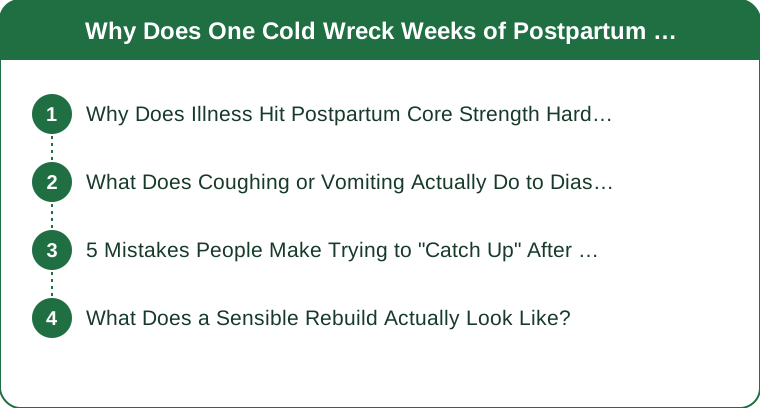
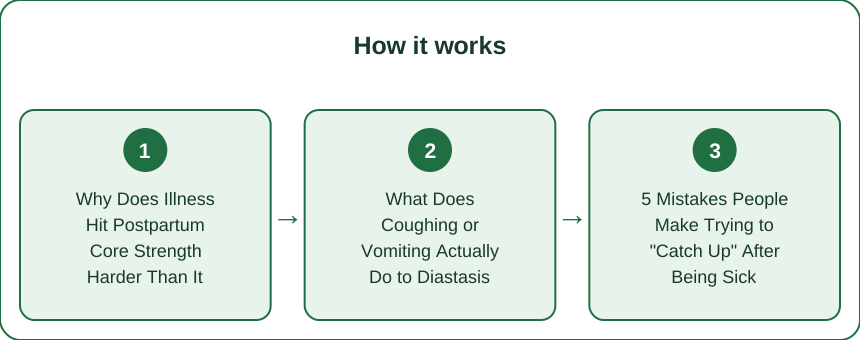
Why Does Illness Hit Postpartum Core Strength Harder Than It Would Pre-Baby?
Postpartum core and pelvic floor tissue is still in an active recovery and remodeling process, often for a full year or more after delivery, particularly around the linea alba (the connective tissue seam down the midline of the abdomen affected by diastasis recti) and the pelvic floor muscles that support it. Tissue that’s still adapting is more sensitive to disruption than fully mature, unstressed tissue — which means the same five-day illness that would barely dent a pre-pregnancy core can meaningfully set back postpartum progress that was still consolidating.
There’s also a simple use-it-or-lose-it neuromuscular factor. The deep core engagement you’ve been rebuilding — the coordinated firing of the transverse abdominis, pelvic floor, and diaphragm — is a motor skill as much as a strength gain. Motor skills that are still being re-learned (as they are for most people well into the first postpartum year) fade measurably faster with a few days off than a skill you’d had for a decade. This is neuromuscular “rustiness,” not actual tissue loss — the muscle fibers themselves don’t meaningfully atrophy in five to seven days, but the fine coordination between them does get harder to access after a break, especially a break that also involved illness stress.
Add in that illness itself is metabolically costly — your body is prioritizing immune response over muscle protein synthesis and recovery — and a few sick days can feel disproportionately like a bigger setback than the calendar suggests it should be.
What Does Coughing or Vomiting Actually Do to Diastasis Recti and the Pelvic Floor?
This is the part that catches a lot of postpartum parents off guard: a hard, repeated cough is a genuine intra-abdominal pressure event, not unlike a poorly-braced heavy lift. Each cough or bout of vomiting drives pressure up sharply through the abdominal cavity, and if the deep core and pelvic floor aren’t coordinating well to manage that pressure (which is common when you’re also sleep-deprived and run-down from being sick), the pressure can push outward against the midline connective tissue or downward against the pelvic floor.
For someone with a diastasis recti that had been narrowing and firming up, a week of a nasty cough — especially the kind that comes with a toddler’s cold, which can mean dozens of coughing episodes a day — can genuinely cause a temporary flare in gap width or doming when you sit up or engage the core. Similarly, someone who’d been rebuilding pelvic floor control might notice a return of leaking with a cough or sneeze that had mostly resolved, simply because repeated high-pressure events overwhelmed a system that was still building capacity, not full strength.
This is usually temporary, not a full return to square one — but it does mean the days right after an illness are a reasonable time to test where things stand (does coughing on purpose cause bulging at the midline? does a firm cough cause leaking?) before resuming your previous exercise intensity, rather than assuming you can jump straight back to where you left off.
5 Mistakes People Make Trying to “Catch Up” After Being Sick
Mistake 1: Jumping back in at your pre-illness level. If planks were at 40 seconds before, don’t start there again — start at 20-25 and build back up over a few sessions. The rebuild is almost always faster than the original build, but it isn’t instant.
Mistake 2: Ignoring new doming or bulging at the midline. If a basic core exercise now causes visible doming that wasn’t there before you got sick, that’s a sign to scale back further and check in with a pelvic floor physical therapist rather than push through it.
Mistake 3: Skipping the breath-and-brace reset. Before loading the core again, spend a session or two just re-practicing the exhale-and-engage pattern (gently drawing in the deep abdominals on an exhale) without any other exercise layered on top — this rebuilds the neuromuscular timing that got rusty faster than pure strength work does.
Mistake 4: Comparing this week to your best week, not your last “normal” week. Progress isn’t linear even without illness; measuring against a peak day sets up a discouraging comparison. Measure against your average from the two weeks before you got sick instead.
Mistake 5: Treating still-fatigued days like ready-to-train days. Recovering from illness (yours or a fragmented-sleep stretch caring for a sick baby) leaves lingering fatigue for several days after symptoms clear. Pushing full core intensity during that window slows the rebuild more than a few extra rest days would.
What Does a Sensible Rebuild Actually Look Like?
Day 1-2 back: Focus purely on breath and gentle engagement — diaphragmatic breathing with a soft exhale-engage of the deep core, done lying down, no other loading. This re-establishes the coordination pattern that fades fastest.
Day 3-4: Reintroduce the exercises you were doing about two steps back from where you left off — if you’d progressed to standing anti-rotation work, drop back to supported dead bugs or bird dogs. Watch specifically for doming, bulging, or any pelvic floor heaviness or leaking, and scale back further if you see it.
Day 5-7: If the above feels clean (no doming, no leaking, breath staying steady through the movement), progress back up roughly one level every session or two rather than jumping multiple levels at once. Most people find they’re back to their pre-illness baseline within one to two weeks — noticeably faster than the original weeks it took to get there, because you’re re-accessing a pattern rather than building one from nothing.
Throughout: keep an eye on cough — if it’s still lingering, avoid heavy bracing or breath-holding moves until it’s mostly resolved, since a residual cough during a loaded exercise is the same high-pressure risk as during illness itself.
The frustrating math of postpartum core work is that setbacks from illness feel disproportionate to how short they are — but the rebuild math works in your favor too. What took you six weeks to build the first time typically takes days, not weeks, to reclaim.
TL;DR:
- Illness hits postpartum core progress harder because the tissue and neuromuscular patterns are still actively remodeling
- Coughing and vomiting are real intra-abdominal pressure events that can temporarily flare diastasis recti or pelvic floor symptoms
- What feels lost is mostly neuromuscular rustiness, not actual muscle loss — it comes back faster than it was built
- Rebuild two steps back from where you left off, re-check for doming or leaking before progressing, and expect one to two weeks back to baseline
- Compare progress to your recent average, not your best day, and don’t train through lingering post-illness fatigue
The setback feels bigger than it is — your core didn’t start over, it just needs a few days to remember where it left off.
See It in Motion
Seen here: Maternity Capris with Side Pockets — shop it on bubblelime.com
Keep Reading
This article is for general informational and styling purposes only. Fit, sizing, and product availability may vary.