Why Does Postpartum Energy Always Crash Around 3pm — And What's Actually Causing It?

Quick Answer: The postpartum 3pm crash is a real, predictable convergence of four factors: a natural afternoon dip in cortisol (your body’s main daytime alertness hormone), blood sugar swings from skipped or rushed meals, the metabolic demand of breastfeeding pulling glucose and calories away from your own energy reserves, and accumulated sleep debt that has no single “recovery night” to fix it. None of these alone would flatten you, but stacked together in the early afternoon, they consistently do. Small, timed adjustments to food, light exposure, and rest expectations blunt it more effectively than another cup of coffee.
If you can set your watch by the moment your energy evaporates most days — usually somewhere between 2 and 4pm — you’re not imagining a pattern, and you’re definitely not failing at something everyone else has figured out. This is general information, not medical advice.

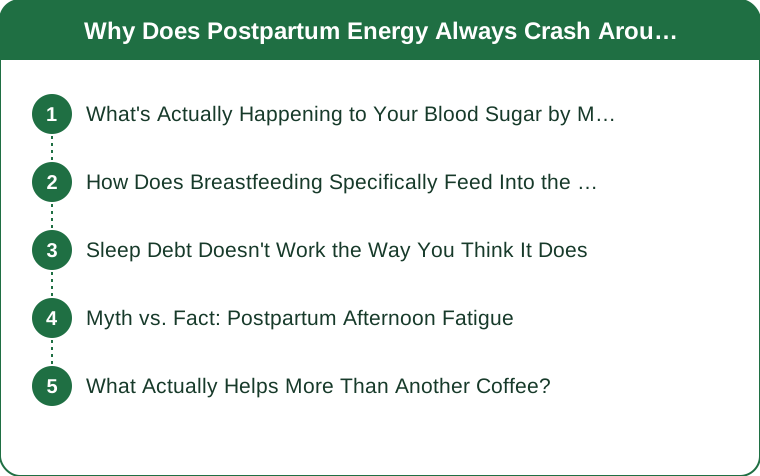
What’s Actually Happening to Your Blood Sugar by Mid-Afternoon?
Blood sugar naturally rises and falls throughout the day in response to meals, but postpartum, the swings tend to be sharper and the recovery slower. Breakfast eaten one-handed while nursing, a lunch that gets interrupted three times or skipped entirely, and coffee standing in for food all set you up for a glucose spike followed by a steeper-than-usual drop a couple of hours later — and that drop tends to land right in the early afternoon.
When blood glucose falls, your body releases counter-regulatory hormones like adrenaline and cortisol to bring it back up, which is part of why a blood-sugar crash feels like more than just tiredness — it can bring a jittery, irritable, “hangry” edge along with the fatigue. If you’re also breastfeeding, your body is continuously diverting glucose toward milk production (breastfeeding burns roughly 300-500 extra calories a day, largely glucose-dependent), which means your own reserves get tapped faster and refill more slowly than pre-pregnancy.
The fix isn’t more caffeine, which can actually worsen the crash by spiking cortisol further and then dropping you harder an hour later. It’s protein and fiber at breakfast and lunch — think eggs with vegetables rather than toast alone, or a lunch with beans or chicken rather than just crackers — because protein and fiber slow glucose absorption and flatten the spike-and-crash curve. A small protein-containing snack around 1:30-2pm, before the crash hits rather than after, can blunt the whole cycle.
How Does Breastfeeding Specifically Feed Into the Afternoon Slump?
Beyond the calorie and glucose demand, breastfeeding involves a hormonal rhythm of its own. Prolactin, the hormone that drives milk production, tends to have a mildly sedating effect — some research on nursing mothers has noted feeling drowsy or relaxed during and shortly after nursing sessions, which is a documented, common experience. If your baby’s early-afternoon feed happens to land during that natural cortisol dip window, you get a double hit: hormonally-driven sleepiness stacked on top of the day’s normal energy low point.
There’s also the simple math of demand. Milk production is metabolically expensive, and your body prioritizes it — which means on days when intake hasn’t kept pace with what feeding requires (skipped meals, not enough fluids, less sleep than usual), your own energy reserves are what gets shorted first. This is your body being efficient at its assigned job, not a personal failure of stamina.
None of this means you need to stop nursing to fix your afternoons — it means the timing of your own food and hydration matters more right now than it used to, and that a slump during or right after a feeding session is physiologically expected, not a sign something’s wrong.

Sleep Debt Doesn’t Work the Way You Think It Does
It’s tempting to believe that one good night will “catch you up,” but sleep debt postpartum tends to be cumulative and doesn’t clear with a single decent stretch. If you’re averaging even 90 fewer minutes of sleep a night than your body needs — extremely common with a baby under a year — that deficit builds across days and weeks. One good night reduces the debt; it doesn’t zero it out.
Sleep debt specifically undermines your body’s ability to regulate the natural afternoon cortisol dip. In well-rested people, cortisol dips gently in early afternoon and there’s enough of a buffer that it doesn’t register as exhaustion. In a sleep-deprived body, baseline cortisol regulation is already strained, so that same dip lands harder and feels more like hitting a wall than a normal lull.
This is why the crash can feel worse on some days than others even when your food and feeding schedule look identical — the sleep debt underneath is the variable shifting day to day. Tracking your rough sleep total (not just hours in bed, but actual uninterrupted sleep) for a week can reveal whether your worst afternoons line up with your least-slept nights, which they usually do.
Myth vs. Fact: Postpartum Afternoon Fatigue
Myth: A crash at 3pm means you should push through with caffeine and willpower. Fact: caffeine after roughly 2pm can worsen the crash’s rebound and disrupt the sleep you’re already short on, making tomorrow’s crash worse, not better.
Myth: If you were getting “enough” sleep, this wouldn’t happen. Fact: even well-rested new parents experience a natural early-afternoon dip in alertness — it’s a normal circadian pattern in humans generally, just amplified by the sleep debt, hormonal shifts, and metabolic demands of the postpartum period.
Myth: A 20-minute walk will just make you more tired. Fact: brief outdoor light exposure and light movement in early afternoon has been shown to help reset circadian alertness signals more effectively than sitting still, and doesn’t carry the crash-after risk that caffeine or sugar does.
Myth: This is permanent. Fact: as sleep consolidates (even gradually, as babies age), meal timing stabilizes, and breastfeeding demands shift (if applicable), the intensity of the afternoon dip for most people gradually eases — it’s tied to a specific, changing set of postpartum conditions, not a new permanent baseline.
What Actually Helps More Than Another Coffee?
Get outside between noon and 2pm if you can, even for ten minutes. Natural light exposure in early afternoon helps regulate the cortisol rhythm and has been shown in sleep research to reduce the depth of the post-lunch dip more reliably than caffeine does.
Front-load protein. A breakfast and lunch with at least 20-25 grams of protein each slows the glucose swings that make the crash sharper. This matters more than cutting carbs entirely — it’s about pairing, not restriction.
Time a small snack for 1:30-2pm rather than reacting once you’re already flattened at 3. Something with protein and a little fat — nuts, yogurt, cheese and fruit — holds blood sugar steadier through the danger window than a sugary “quick fix” that spikes and drops you again 45 minutes later.
Lower the bar on what “recovery” looks like today. If sleep debt is the layer you can’t fix in an afternoon, plan around it: save lower-stakes tasks for 2-4pm and higher-focus ones for morning or evening if your schedule allows any flexibility at all.
The crash is real, it’s explainable, and it’s not a signal that something is uniquely wrong with you — it’s four ordinary postpartum systems overlapping at the same hour of the day.
TL;DR:
- The 3pm crash stacks four real factors: normal circadian cortisol dip, blood sugar swings, breastfeeding’s glucose demand, and cumulative sleep debt
- Breastfeeding’s prolactin can add mild natural drowsiness, especially if a feed lands during the afternoon dip
- Sleep debt is cumulative — one good night reduces it but doesn’t erase it
- Protein-forward meals, a timed early-afternoon snack, and 10 minutes of outdoor light beat caffeine for blunting the crash
- It’s a predictable, temporary convergence tied to this specific season of postpartum life, not a personal energy failure
You’re not losing your stamina — you’re running four overlapping systems at once, and 3pm is just where they all meet.
See It in Motion
Seen here: Maternity Capris with Side Pockets — shop it on bubblelime.com
Keep Reading
This article is for general informational and styling purposes only. Fit, sizing, and product availability may vary.