Why Month Four Postpartum Is Harder Than Month Two

Quick Answer: Month four is commonly harder than month two because the practical support has ended, sleep is often worse rather than better, and the cultural six-week recovery narrative has left you expecting to feel fine. Physically, connective tissue and pelvic floor recovery run for six to twelve months, and hormonal changes around weaning or returning to work land in this window. It is a predictable dip, not a personal failure.
Almost nobody is warned about this stretch, which is a large part of why it feels like something has gone wrong.

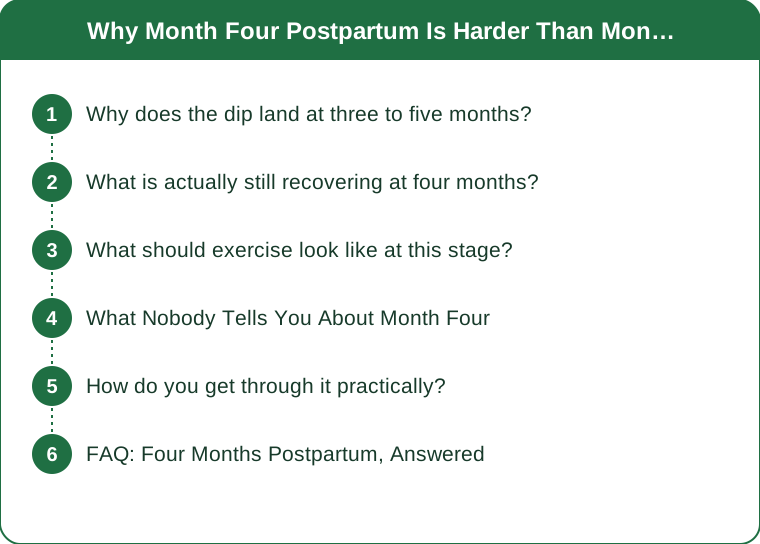
Why does the dip land at three to five months?
Four things converge, and they converge for structural reasons rather than by coincidence.
The support ends. Visitors stop, meals stop, partners return to work, and in most of the US any parental leave has ended or is ending. The practical load increases at exactly the point where you are still recovering.
Sleep often gets worse, not better. Many babies have a significant sleep disruption somewhere around this age, and by month four the cumulative deficit has been building for over a hundred nights. Sleep deprivation is cumulative in a way most people underestimate - month four exhaustion is not month one exhaustion, it is month one exhaustion plus twelve more weeks.
The six-week narrative has expired. You were discharged at six weeks and told you were cleared. Everyone around you now assumes you are recovered, and the gap between that assumption and how you actually feel is its own weight.
Hormonal shifts land here. Returning to work, reducing breastfeeding, or the return of periods all commonly happen around this window, and each involves a hormonal change that affects mood, energy, and sleep.
What that adds up to: less support, more demand, no less fatigue, and an expectation that you are fine. That is a difficult combination for anyone, and it is the standard shape of month four rather than a sign that something has gone wrong for you specifically.
What is actually still recovering at four months?
More than the six-week clearance implies. Several tissues are on a six to twelve month timeline.
Abdominal connective tissue. The linea alba - the tissue between the abdominal muscles that stretched during pregnancy - continues remodelling well past six months. Some degree of separation at four months is normal and often continues to improve. What matters more than the gap width is whether you can generate tension across it.
Pelvic floor. Muscle strength can improve considerably in the first few months, but full recovery of function commonly takes six to twelve months, and longer after a difficult delivery. Leaking when you sneeze, run, or jump at four months is common and is not something you have to accept as permanent - it is one of the most treatable things on this list.
Joint laxity. Relaxin and the other hormonal changes of pregnancy affect ligaments, and joint stability takes months to return, sometimes longer with continued breastfeeding. This is why pelvic and lower back pain can persist or even appear at this stage.
Blood volume, iron, and thyroid. Iron depletion after delivery is common and it produces exactly the fatigue people attribute purely to sleep deprivation. Postpartum thyroiditis also typically presents somewhere in the first several months and is frequently missed, because its symptoms - exhaustion, mood changes, hair loss - are assumed to be normal new-parent experience.
That last point is the practically important one. If your exhaustion feels disproportionate even accounting for the sleep, ask for blood work - iron, ferritin, and thyroid function. It is a simple test and this is exactly the window in which it finds things.
This is general information, not medical advice. Persistent pain, leaking, heaviness or dragging in the pelvis, or exhaustion that does not track with your sleep all warrant a proper assessment.
What should exercise look like at this stage?
Rebuilding foundations, not returning to what you did before. And the order matters.
Start with breathing and pressure management. This sounds unbearably basic and it is the thing everything else is built on. Lie on your back, knees bent, hand on your ribs. Inhale and let the ribs widen; exhale and feel the deep abdominal wall gently draw in. Ten breaths, twice a day. This coordinates the diaphragm, deep abdominals, and pelvic floor, which is the system that manages pressure during any load.
Then add loaded basics, two to three times a week:
- Glute bridge, 3 sets of 10, exhaling as you lift
- Bodyweight squat to a chair, 3 sets of 10
- Bird dog, 3 sets of 8 each side
- Side-lying leg lift, 3 sets of 12 each side
- Wall push-up or incline push-up, 3 sets of 8
- Suitcase carry with one weight, 3 sets of 20 seconds each side
Progress by adding load, not reps. A heavier weight for eight reps rebuilds strength faster than more repetitions of bodyweight, and it is more time-efficient, which matters enormously right now.
Walking counts and is genuinely valuable. Twenty minutes outside does more for mood and energy at this stage than a harder session you will not recover from.
What to hold off on until you have been assessed: running, jumping, and heavy abdominal work. Most guidance suggests returning to running somewhere around three to six months at the earliest, with the caveat that it should be based on symptoms and capacity rather than the date. If you leak, feel heaviness, or feel your abdominal wall dome outward under load, that is a signal to get assessed before progressing - not a signal to push through.
Pelvic floor physiotherapy is the single highest-value thing available to most people in this window, and in much of the US it is accessible without a referral. It is routine care after birth in several countries and skipped by default here, which is the main reason avoidable problems become long-term ones.

What Nobody Tells You About Month Four
The six-week clearance is an appointment, not a finish line. It checks for specific complications. It is not a comprehensive assessment of whether your abdominal wall and pelvic floor are ready for load, and it was never intended to be.
Hair loss peaks around now and it can be dramatic enough to be genuinely distressing. It is a normal shedding phase after the pregnancy hormones shift, and it stops. Almost nobody is warned, and a lot of people conclude something is wrong with them.
The mood dip at four to six months is common and under-discussed. Postpartum depression and anxiety can begin or intensify well after the newborn period, and screening usually happens much earlier. If you have felt persistently low, anxious, disconnected, or unable to enjoy things for more than a couple of weeks, that is a reason to contact someone - not a reason to wait and see whether it improves.
Comparison gets worse at this stage, not better. Everyone who gave birth around the same time as you is now visible again, and some of them look like they have bounced back. Recovery timelines vary enormously based on delivery, feeding, sleep, support, and prior fitness. What you see is not a measure of how you are doing.
Your body may not return to its previous shape, and that is a different thing from not recovering. Ribcage width, hip width, and foot size all commonly change permanently. Functional recovery - strength, continence, no pain - is the meaningful goal and it is achievable. Returning to a previous appearance is a separate question with a less predictable answer.
The people who feel best at nine months are usually the ones who did less at four, not more. The pattern that goes wrong most often is an aggressive return at three months, a setback, and a stop-start cycle that runs for a year.
How do you get through it practically?
Five things, in order of what actually helps most.
Get the blood work. Iron, ferritin, thyroid, and vitamin D. If the exhaustion has a treatable physical component, everything else on this list works better afterward. This is the highest-value single action available.
See a pelvic floor physiotherapist, whether or not you have symptoms. One assessment tells you what your abdominal wall and pelvic floor can currently handle, which converts a guessing game into a plan. If cost is a barrier, ask - many practices have options, and some insurance covers it.
Protect one block of sleep. Not more total sleep, which may not be available, but one uninterrupted stretch of four or five hours a few nights a week, with someone else covering. Fragmented sleep and consolidated sleep are not equivalent, and a protected block does more than an extra hour spread thin.
Lower the bar on exercise until it fits. Fifteen minutes, three times a week, is a programme. An hour four times a week is a plan that fails in week two and then produces guilt on top of exhaustion. The version you actually do is the effective one.
Say the thing out loud. To a partner, a friend, a doctor, a group. Month four is isolating specifically because the visible support has ended and the assumption is that you are through it. Naming that this stretch is hard is not complaining - it is the most accurate description of a normal and predictable phase.
And the timeline, honestly: most people describe things easing meaningfully somewhere between six and nine months, as sleep consolidates and connective tissue recovery catches up. Four months is not the plateau. It is the trough, and troughs end.
If you are experiencing thoughts of harming yourself or your baby, feeling unable to cope, or persistent hopelessness, contact your doctor or a crisis line straight away - this is urgent and treatable, and it is more common than anyone tells you.
FAQ: Four Months Postpartum, Answered
Is it normal to feel worse at four months than at two?
Very. The support ends, the sleep debt accumulates, and hormonal changes around work or feeding often land here. It is a recognised dip, not a sign of a setback.
When can I start running again?
Most guidance points to three to six months at the earliest, based on symptoms and strength rather than the calendar. Leaking, heaviness, or pain during or after are signals to get assessed rather than to push on.
Should my abdominal separation have closed by now?
Not necessarily. Connective tissue continues remodelling for many months, and the ability to generate tension across the gap matters more than the width of it. A physiotherapist can assess both.
Why am I losing so much hair?
A normal post-pregnancy shedding phase that typically peaks around three to five months and resolves. If it is accompanied by significant fatigue or other symptoms, it is worth checking thyroid function.
How long until I feel like myself?
Most people describe a meaningful shift somewhere between six and nine months, and it tends to track sleep more than anything else. It is slower than the culture suggests and it does come.
TL;DR:
- Month four is a predictable dip: support ends, sleep debt peaks, expectations arrive
- Connective tissue and pelvic floor recovery run six to twelve months, not six weeks
- Get iron, ferritin, and thyroid checked - this window is when they show up
- Rebuild with breathing, loaded basics, and walking; hold running until assessed
- A pelvic floor physio assessment is the highest-value thing available and routinely skipped
Nothing has gone wrong. This stretch is harder than the one before it for reasons that have names, and it is the trough rather than the plateau.
See It in Motion
Seen here: Maternity Capris with Side Pockets — shop it on bubblelime.com
Keep Reading
This article is for general informational and styling purposes only. Fit, sizing, and product availability may vary.