Why Pelvic Floor Symptoms Come Back Around Month Nine Postpartum

Quick Answer: A return of pelvic floor symptoms around month nine is common and rarely means your recovery reversed. Four things typically change at once around this point: your baby gets substantially heavier and more mobile, you return to higher-impact training, breastfeeding often reduces or stops which shifts hormone levels, and the pelvic floor exercises that were daily at month two have usually stopped. Any one of those alone is manageable. Together they raise demand while lowering capacity, and symptoms reappear.
It is a demoralising moment because it feels like going backwards after doing everything right. It is almost always a load problem rather than a healing problem, and load problems are fixable.

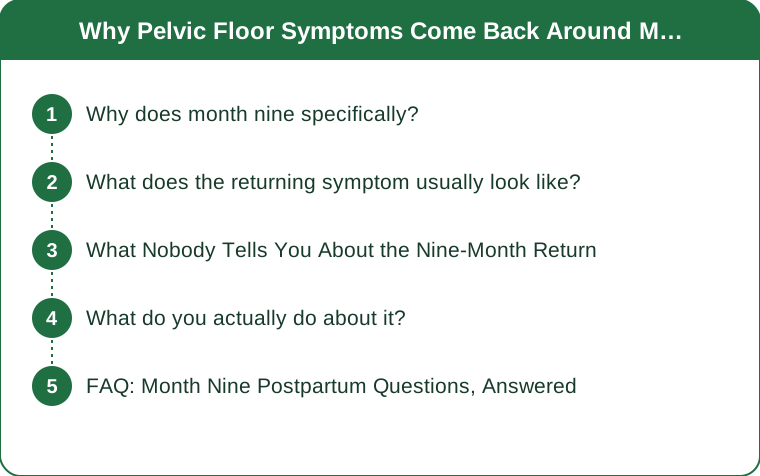
Why does month nine specifically?
Because it is where four separate curves cross. None of them are dramatic on their own, which is why the return feels like it came from nowhere.
Your baby roughly tripled in weight. A newborn is around 3.5 kg. A nine-month-old is often 9 kg, and unlike a newborn, they move while you carry them. You are now performing dozens of asymmetric loaded lifts a day, frequently from a bent-over position, with an unstable load. Nobody would programme that, and nobody counts it as training.
They also became mobile. Crawling means you are getting up and down off the floor constantly, often quickly, often while holding something.
Your training got harder. Around eight or nine months most people who were walking and doing bodyweight work start running again, or return to a class with jumping. Impact loading is a genuinely different demand from anything in the first six months.
Breastfeeding often reduces around this point. Lower prolactin and the return of ovulation means oestrogen levels rise, which is generally helpful for tissue - but the transition period itself can come with a few unsettled months, and many women stop the daily pelvic floor work around the same time simply because life got busy.
What does the returning symptom usually look like?
Most commonly leaking with impact, or a heaviness that appears late in the day rather than in the morning. The timing detail is the most useful diagnostic information you have.
Symptoms that are worse in the evening and absent on waking indicate a fatigue-related capacity issue - the tissue manages fine when fresh and runs out of margin as the day accumulates. This is the classic month-nine pattern and it responds well to load management.
Symptoms that are present first thing in the morning, or that are constant, are a different picture and warrant an assessment rather than a self-managed programme.
Leaking specifically with running or jumping, but not with coughing or sneezing, points to a timing and coordination gap rather than a strength gap - the pelvic floor is strong enough but is not activating quickly enough for the rapid pressure changes of impact.
Leaking with a cough or sneeze as well suggests capacity is genuinely low and strength work should come first.
Heaviness or a dragging sensation, particularly after being on your feet, should be assessed by a pelvic health physiotherapist. This is general information rather than medical advice, and prolapse symptoms are much better managed early.

What Nobody Tells You About the Nine-Month Return
The first thing: you did not lose your progress. Tissue quality does not regress between month six and month nine. What changed is the ratio of demand to capacity, and both sides of that ratio moved in the wrong direction at once.
The second: carrying your baby is the largest untracked load in your week. If you carried a 9 kg dumbbell on one hip for two hours a day, you would consider it a training block and programme around it. Most women carry their baby predominantly on one side without noticing which, and that asymmetry loads one side of the pelvic floor considerably more.
The third: the return of your period frequently brings a cyclical pattern of symptoms that was not there before. Many women find symptoms are noticeably worse in the days before menstruation. It is not a deterioration - it is a monthly fluctuation that was invisible while you were not cycling.
The fourth, and the one that causes the most unnecessary distress: this timing is common enough that pelvic health physiotherapists see it constantly, and it usually resolves within six to eight weeks of appropriate management. The women who struggle longest are typically the ones who interpret it as failure and either stop training entirely or push harder - both of which make it worse.
What do you actually do about it?
Reduce impact temporarily, restart the daily work, and fix the carrying asymmetry. In that order.
Impact. Halve it for three weeks rather than stopping. If you are running 20 minutes, run 10 and walk the rest. If class has jumping, do the low-impact option. Complete rest deconditions the tissue and makes the return harder.
Daily work, properly. Ten slow contractions with a full release between each, plus ten quick ones, twice a day. The quick contractions matter specifically for the impact-timing gap, and they are the ones almost everyone skips. Set a phone reminder - the reason it stopped at month six is that it was never anchored to anything.
Carrying. Notice which hip you default to, and deliberately alternate. Use a carrier for anything over ten minutes. This single change often produces the clearest improvement because it is the biggest daily load.
Then rebuild impact gradually. After three weeks, add back 10 percent of duration per week. If a symptom appears, drop to the previous week and hold rather than pushing on.
If there is no improvement in six weeks, or if there is heaviness rather than leaking, see a pelvic health physiotherapist. One assessment usually identifies the specific issue faster than months of general work.
FAQ: Month Nine Postpartum Questions, Answered
Does this mean I went back to running too early?
Usually no. It more often means the running progressed at the same time as the carrying load tripled, and the combination exceeded capacity. The running is rarely the sole cause.
Will it happen again if I have another baby?
A previous episode does raise your risk, which is a good reason to keep the daily work going long term rather than stopping once symptoms resolve. Think of it as ongoing maintenance rather than rehabilitation.
Is it too late to fix at nine months?
Not at all. There is no closing window - the pelvic floor responds to training at any point postpartum, including years later. The idea that you have to fix it in the first six months is one of the more harmful pieces of received wisdom in this space.
TL;DR:
- Month nine is where four changes converge: a much heavier mobile baby, returning impact training, shifting hormones, and abandoned daily exercises.
- It is a demand-versus-capacity problem, not a reversal of healing.
- Evening-only symptoms point to fatigue and manage well; morning or constant symptoms need an assessment.
- Halve impact for three weeks rather than stopping, restart both slow and quick contractions twice daily, and fix your carrying asymmetry.
- Rebuild by 10 percent a week, and see a pelvic health physio for heaviness or for no change after six weeks.
The return at nine months is one of the most predictable things in postpartum recovery, and one of the least talked about. Knowing it is coming is most of the work.
See It in Motion
Seen here: Maternity Capris with Side Pockets — shop it on bubblelime.com
Keep Reading
This article is for general informational and styling purposes only. Fit, sizing, and product availability may vary.