Why Postpartum Core Work Stalls Around Month Six

Quick Answer: Early postpartum core work - breathing, gentle activation, heel slides - is a reconnection stage, and it is genuinely effective for the first few months. It plateaus because it is low-load work and, once the connection is restored, low load no longer challenges the system. Progressing means adding load, lever length, and anti-movement work rather than repeating the reconnection exercises more often. Symptoms, not the calendar, decide the pace - and a pelvic health physiotherapist is the right person to set it.
Month two, everything was improving. Month six, you are doing the same exercises with the same diligence and nothing has changed since spring.

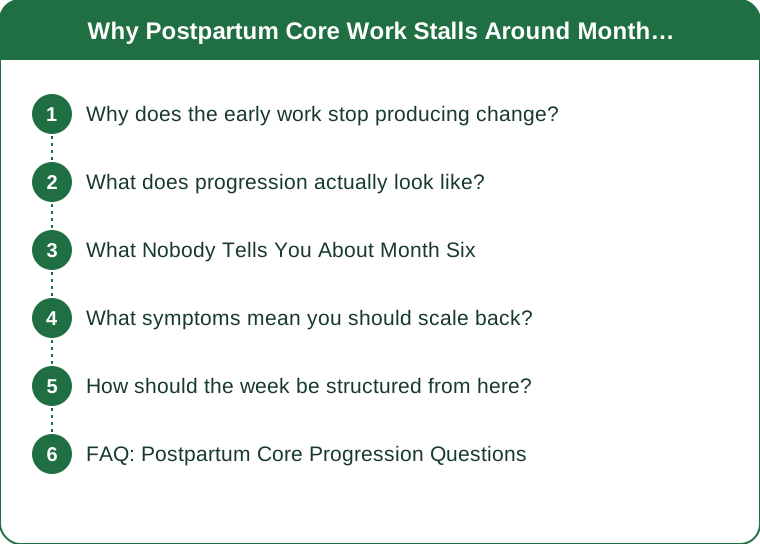
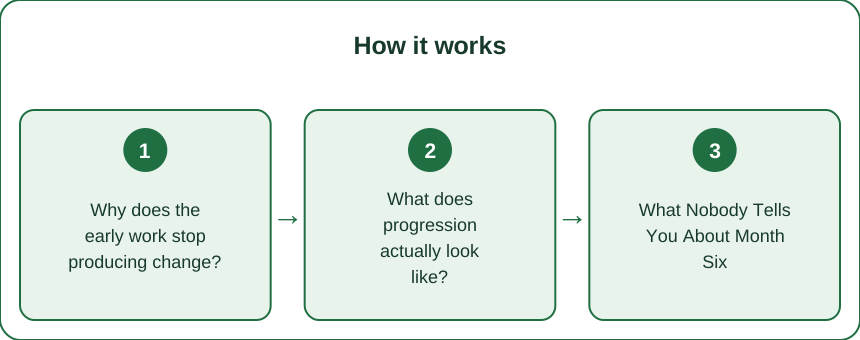
Why does the early work stop producing change?
Because the early stage is about restoring a connection, and that job finishes. Breathing coordination, gentle transverse abdominis activation, and pelvic floor awareness address a real problem - the timing between diaphragm, deep abdominals, and pelvic floor is genuinely disrupted after pregnancy and birth. Once that timing returns, repeating the exercise no longer challenges anything.
Low load builds low-load capacity. These exercises are deliberately gentle, and gentle work develops the ability to do gentle work. It does not prepare the system for carrying a toddler up stairs, which is the actual demand of month six.
Progressive overload applies to core training like anything else. The abdominal wall and pelvic floor are muscle, and muscle adapts to increasing demand. A programme with no progression produces exactly what any unprogressed programme produces.
Most postpartum programmes are written for the first twelve weeks, because that is where the demand is, and they simply stop rather than pointing to a next stage. Following one diligently past its intended window is a very common and entirely reasonable mistake.
And measurable early change was partly swelling and tissue recovery, which resolves on its own timeline. When that natural resolution finishes, the exercise-driven portion of the change becomes visible for what it is - which feels like a sudden stall.
What does progression actually look like?
Lengthen the lever before you add weight. Bent-knee work progresses to extended-leg work; a knee plank progresses to a full plank. Increasing the distance from the working muscles to the load is a substantial increase in demand and requires no equipment.
Add anti-movement work, which is what the core actually does. Anti-extension (planks, dead bugs), anti-rotation (Pallof presses, single-arm carries), and anti-lateral-flexion (suitcase carries, side planks). These train the trunk for its real job - resisting movement while limbs work - and they are largely absent from early rehab programmes.
Loaded carries deserve specific mention. A suitcase carry with a genuinely heavy weight in one hand is one of the most useful and most under-used postpartum core exercises, and it maps directly onto carrying a child on one hip.
Add load to compound lifts. Squats, deadlifts, and overhead pressing all demand significant trunk control, and progressing them progresses the core alongside everything else. For most people past the early stage, this is more effective than any isolated core exercise.
Reintroduce flexion work gradually if symptoms allow. Curl-ups and similar movements are not permanently forbidden - they are inappropriate early and frequently reintroducible later, guided by symptoms and by someone who has assessed you.
And progress one variable at a time. Longer lever, or more load, or more repetitions - not all three in the same week. The postpartum abdominal wall gives clear feedback, and single-variable progression is what lets you read it.
What Nobody Tells You About Month Six
Six months is not a finish line, and connective tissue keeps changing well beyond it. Recovery timelines vary enormously between individuals, and continued improvement past a year is common. The idea that things are as good as they are going to get at six months is not supported by how the tissue behaves.
Sleep deprivation affects your training more than the exercise selection does. Chronic short sleep impairs recovery, motivation, and coordination, and month six is frequently a poor sleep period. A plateau during a bad sleep stretch is not necessarily a programme problem.
Breastfeeding, hormones, and energy availability all interact with recovery, and under-eating while breastfeeding is a common and under-recognised reason that training stops producing results.
The doming or coning that appears with harder exercises is information, not a verdict. It signals that the current exercise exceeds what the abdominal wall can currently manage in that position - which means regress the variation, not abandon core work.
Gap width matters less than tension. Current understanding places more emphasis on the ability to generate tension across the linea alba than on the raw width of any separation, which is why some people with a measurable gap have excellent function and some with a small one do not.
And returning to running or impact is a separate question with its own criteria - typically including symptom-free loading, adequate strength, and often a minimum time frame, and it is worth assessing properly rather than testing on a whim.

What symptoms mean you should scale back?
Doming or coning along the midline during an exercise. Regress to an easier variation of the same movement rather than stopping core work altogether - the exercise is too hard, which is different from the movement being unsafe.
Any leaking of urine during an exercise. This is common, it is not something to accept as permanent, and it is highly treatable. It is a clear signal to see a pelvic health physiotherapist rather than to push through or to quit exercising.
A feeling of heaviness, dragging, or bulging in the pelvis, particularly worsening through the day or with load. This warrants assessment before continuing to progress load.
Back pain that appears with progression frequently indicates a trunk control issue rather than a back issue, and it usually responds to regressing the exercise and rebuilding rather than to rest.
Pain anywhere, at any point. Postpartum training should be uncomfortable in the way training is uncomfortable, not painful.
And significant, ongoing symptoms deserve a proper assessment regardless of how long it has been. Pelvic health physiotherapy is effective years postpartum, and a great many people who assume it is too late find it is not. This is general information, not medical advice - see a pelvic health physiotherapist or your doctor for individual guidance, particularly before progressing load with any of the symptoms above.
How should the week be structured from here?
Two to three full-body strength sessions rather than daily core work. The trunk works hard in a well-designed strength session, and isolated core work is a supplement rather than the main event.
Five to ten minutes of specific core work attached to those sessions. Anti-rotation, anti-extension, and a loaded carry. That is enough, and it is more than most people are doing.
Keep breathing coordination as a warm-up, not as the programme. Two minutes of connecting breath, pelvic floor, and deep abdominals before loading is genuinely useful. Twenty minutes of it as the whole session, in month six, is the plateau.
Progress the load in the compound lifts on a schedule. Small, regular increases, tracked. This is the engine of change and it is what most postpartum programmes lack entirely.
Walk, and build the amount you walk. It is the most under-rated postpartum training there is, it loads the system in a functional way, and it scales easily.
And accept that adherence beats optimisation. Three sessions a week that happen in a house with a small child in it will outperform a perfect five-session plan that does not survive contact with a nap schedule.
FAQ: Postpartum Core Progression Questions
Why has my postpartum core recovery stalled?
Usually because the early exercises did their job. Breathing work and gentle activation restore coordination, and once that is restored, low-load work no longer challenges the system. Progression means longer levers, added load, and anti-movement work rather than more repetitions of the reconnection exercises.
When can I do harder core exercises after birth?
Symptoms guide it more usefully than the calendar. If a movement produces doming, leaking, pelvic heaviness, or pain, it is currently too hard - regress the variation rather than abandoning core work. A pelvic health physiotherapist can assess where you are and set the progression.
Is doming during exercise a bad sign?
It is information rather than damage - it indicates the exercise exceeds what your abdominal wall can currently control in that position. Regress to an easier version of the same movement and progress again from there. Current thinking emphasises the ability to generate tension across the midline over the raw width of any gap.
Is it too late to fix postpartum core problems years later?
No. Pelvic health physiotherapy is effective years postpartum, and connective tissue continues to respond to loading well beyond the first year. Persistent leaking, heaviness, or pain are treatable at any point and worth getting assessed. This is general information, not medical advice.
TL;DR:
- Early postpartum core work restores coordination, and once that job is done, low-load work stops challenging anything.
- Progress by lengthening levers, adding load, and adding anti-movement work - planks, Pallof presses, and loaded carries.
- Suitcase carries map directly onto carrying a child on one hip and are badly under-used.
- Two or three full-body strength sessions with progressive load beat daily isolated core work.
- Doming, leaking, pelvic heaviness, or pain mean regress the variation and get assessed - not stop training.
- Six months is not a finish line; tissue continues responding well past a year, and physiotherapy works years later.
The programme did not fail. You outgrew it. This is general information, not medical advice.
See It in Motion
Seen here: Maternity Capris with Side Pockets — shop it on bubblelime.com
Keep Reading
This article is for general informational and styling purposes only. Fit, sizing, and product availability may vary.