Why Postpartum Progress Stalls the Month You Finally Start Sleeping

Quick Answer: When sleep improves, most people increase training volume sharply and simultaneously, often doubling it inside a fortnight. Postpartum connective tissue and the pelvic floor adapt more slowly than energy does, so the stall is a load-tolerance problem, not a motivation or metabolism problem.
For months the limiting factor was obvious: you were exhausted. Then the baby starts sleeping through, you get two solid weeks, you feel like yourself — and your training goes backwards.

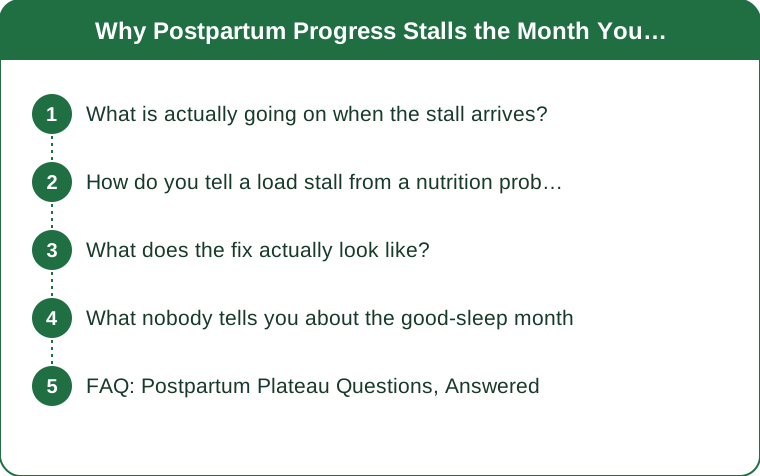
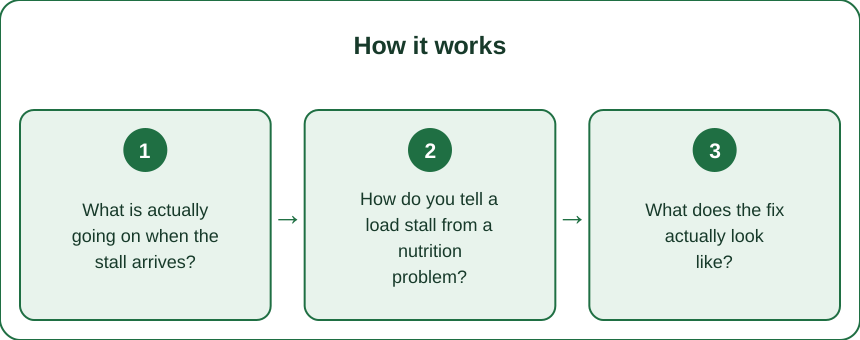
What is actually going on when the stall arrives?
The stall is almost always the result of one change made too enthusiastically: volume went up faster than tissue tolerance did.
During the broken-sleep months, your training was self-limiting. You did what you could, which was usually the right amount, because fatigue capped it. When sleep improves, that cap comes off overnight, and the increase is rarely gradual — people go from three short sessions to five long ones in a fortnight, add running back, and start lifting closer to failure, all at once.
Energy is not the same as readiness. Tendon and ligament remodelling after pregnancy continues for many months, and the pelvic floor’s capacity to manage load under fatigue improves on its own timeline regardless of how well rested you are. You have removed the constraint that was protecting you without removing the underlying limitation.
The result is a fortnight of feeling great followed by a month of feeling flat, achy, and stuck. Common markers: a heaviness that returns after it had gone, a niggle in the hip or foot, sessions that leave you drained rather than energised, and weights that stop moving despite better sleep.
This pattern clusters around months five to eight for most people, which is also when it gets misread as a metabolic plateau.
How do you tell a load stall from a nutrition problem?
They get confused constantly, and the wrong fix makes things worse. Three distinguishing signs.
Timing relative to the sleep change. A stall that begins within two to four weeks of a significant sleep improvement is a load story. A stall that has been slowly developing over two months while everything else was stable is more likely nutrition or overall stress.
Which sessions feel worst. Load stalls hit strength sessions and impact hardest, and leave walking and easy movement fine. Under-fuelling hits everything, including mood and easy sessions, and often comes with cold hands, poor sleep despite the opportunity, and irritability.
Whether symptoms are local or global. A specific hip, foot, or pelvic floor symptom points at load. Global flatness with no local complaint points at fuelling, thyroid, or iron — all worth testing, especially if you are still breastfeeding.
If you are breastfeeding, add roughly 300 to 500 calories a day and expect appetite to be a reasonable guide once sleep is decent. Undereating during the exact month you increase training is a genuinely common way to turn a load stall into both problems at once. This is general information, not medical advice; persistent fatigue deserves a blood test rather than a guess.

What does the fix actually look like?
Not stopping. Sequencing.
Week 1: cut total volume by about a third and keep the frequency. Same number of sessions, shorter. This is counterintuitive to almost everyone and it works because frequency maintains the adaptation while volume is what is overloading tissue.
Weeks 2 to 4: add back one variable at a time. Either intensity or volume or impact — not two. 3 sets of 8 with 90 seconds rest, two reps short of failure, and add either one set per exercise or one session per week, not both.
Impact goes last. Running, jumping, and plyometrics load the pelvic floor and tendons in ways that lifting does not, and they are usually what tipped the balance. If you added running back the month sleep improved, that is the first thing to reduce and the last thing to restore.
Give it six weeks before judging. Tissue tolerance responds slower than fitness, and the temptation at week three — when you feel good again — is to jump straight back to the volume that caused the problem.
One practical marker to track: can you do your session and still want to move the next day? That question is a better readiness gauge than any number, and it costs nothing to ask.
What nobody tells you about the good-sleep month
The stall often arrives with your best mood in a year, which makes it hard to read. You are not tired or low. You just are not progressing, and the mismatch is confusing enough that people go looking for complicated explanations.
Your bodyweight may move for the first time in months, in either direction. Sleep improvement changes appetite regulation substantially, and it is normal for weight to shift a little as things settle. It is a poor moment to start a deficit.
Pelvic floor symptoms can reappear after having resolved. This alarms people badly, and in the context of a volume jump it is usually load tolerance rather than a step backwards. It is still worth seeing a pelvic health physiotherapist rather than waiting it out — that is exactly the situation they are good at.
The month you feel most capable is the month you are most likely to get hurt. Injuries in this population cluster right here, at the point where confidence and energy return before tissue capacity does.
Comparison gets worse, not better. With energy back, people start looking at what others are doing again, which is how a sensible ramp becomes an ambitious one. The person whose programme you are borrowing is at a different point in a timeline that is genuinely invisible from outside.
FAQ: Postpartum Plateau Questions, Answered
How long does this stall usually last?
Four to six weeks when it is handled by reducing volume and rebuilding gradually. Considerably longer when the response is to push harder, which is the more common instinct.
Should I stop training entirely for a week?
Rarely necessary and usually counterproductive. Keeping frequency while cutting session length preserves the habit, the coordination, and the mood benefit, all of which are hard to rebuild.
Can I still lose weight during this period?
You can, but it is a poor month to try. You are simultaneously asking your body to tolerate more load and less fuel while it is still remodelling. Get the training settled first, give it six weeks, then revisit — the outcome is better and the process is far less miserable.
TL;DR:
- The stall usually starts within two to four weeks of sleep improving, because volume jumps faster than tissue tolerance.
- Distinguish it from a fuelling problem by timing, by which sessions feel worst, and by whether symptoms are local or global.
- Fix it by cutting volume roughly a third while keeping frequency, then adding back one variable at a time, with impact last.
- The good-sleep month is when injuries cluster — confidence returns before capacity does.
If you have just come out of the broken-sleep phase and everything has gone flat, the timing is the clue and it is genuinely good news: this is the most fixable kind of plateau there is. Cut the volume this week rather than adding to it, and give the ramp six weeks.
See It in Motion
Seen here: Maternity Capris with Side Pockets — shop it on bubblelime.com
Keep Reading
This article is for general informational and styling purposes only. Fit, sizing, and product availability may vary.