Why Your Postpartum Training Has to Change Once the Baby Starts Pulling Up to Stand

Quick Answer: Once your baby starts pulling up to stand, your postpartum training needs to shift toward functional strength — deep squats, single-leg stability, and quick transitions from floor to standing — because these are now the exact movements you’re doing dozens of times a day catching a wobbling baby.
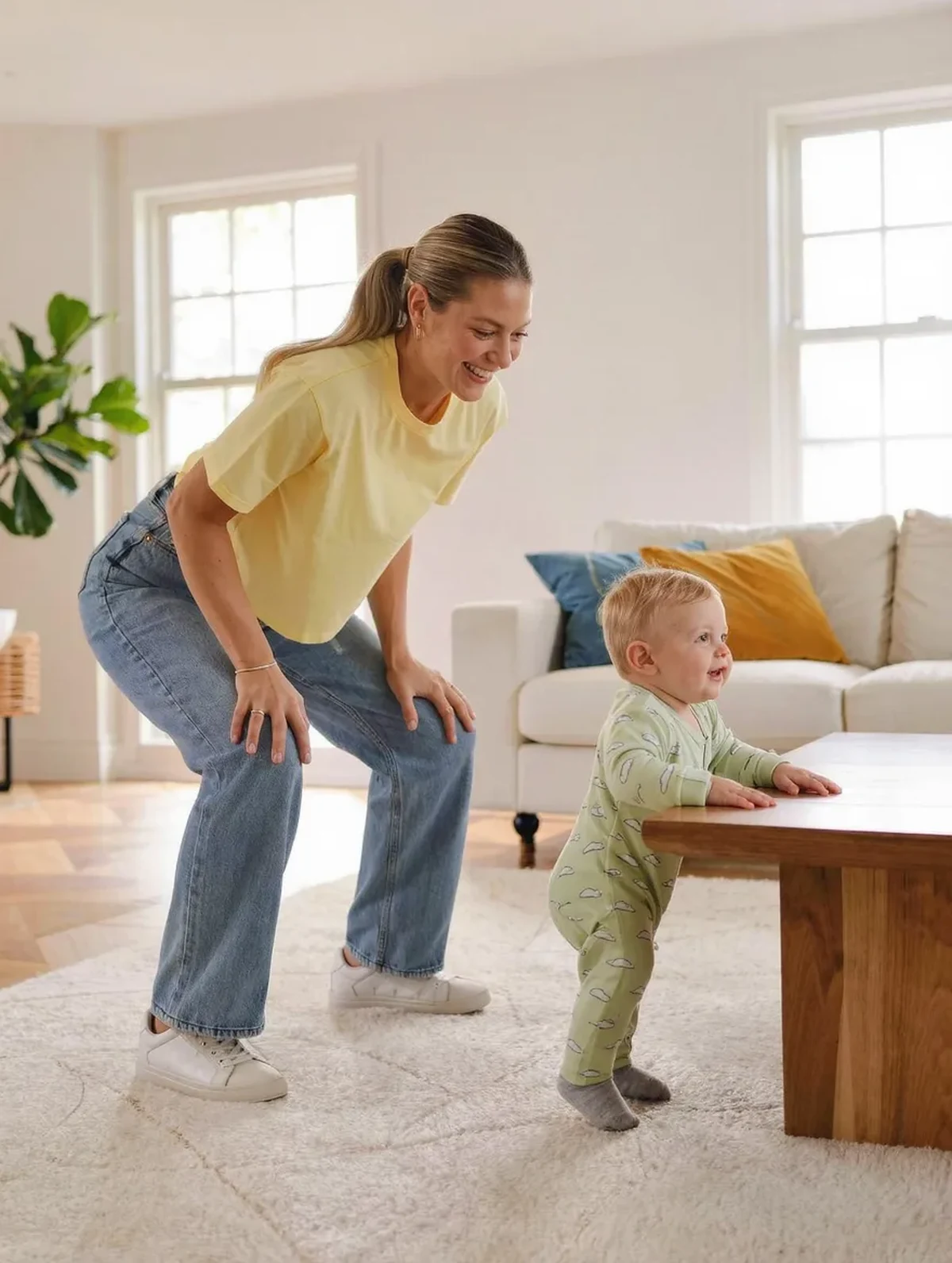
Somewhere between eight and ten months, your baby figures out how to pull up on the coffee table, and your workouts stop being separate from your day. You’re now doing an unplanned squat-and-catch a dozen times before lunch. Training around this milestone, instead of ignoring it, makes both parts of your day easier.

Why does this specific milestone matter more than earlier ones?
Rolling and sitting up don’t demand much from you physically. Crawling asks for some floor mobility. But pulling up to stand is the first milestone that puts your baby in a genuinely unstable position, which means you’re now the safety net for real falls, multiple times an hour, for weeks until they stabilize.
That means fast, low, controlled movement — dropping to catch, guiding a wobble, scooping up from a near-fall — becomes a daily physical demand whether your training accounts for it or not.
What movements matter most for this stage?
Three patterns cover almost everything this milestone throws at you:
- Deep squats with fast entry and exit — you’ll drop into this position from standing dozens of times a day
- Single-leg stability — catching a falling baby rarely happens with both feet planted evenly
- Floor-to-stand transitions — going from sitting on the floor to fully upright, quickly, without using your hands to push off every time
Build these into your routine specifically, rather than a generic postpartum program, and the daily catches start feeling easier almost immediately.
Myth vs Fact: Training Around the Standing Milestone
Myth: This phase is too chaotic to train through, so just wait it out. Fact: This is exactly the phase where targeted training pays off fastest, because you’re using these movement patterns constantly outside the gym too — the carryover is immediate and obvious.
Myth: You need new equipment to train for baby-catching strength. Fact: Bodyweight squats, lunges, and floor-to-stand transitions cover almost all of it. This is one of the more equipment-light phases of postpartum training.
Myth: Your baby pulling up means your postpartum recovery phase is basically over. Fact: Tissue healing timelines don’t follow your baby’s milestones. Many people are still working on core and pelvic floor strength well past this point — the training focus shifts, but the underlying recovery work continues in parallel.
How do you fit this into a day that has zero spare time?
You don’t need a separate session. Turn the catches you’re already doing into deliberate reps: when your baby reaches to pull up, consciously drop into a full, controlled squat instead of a quick unthinking crouch. When you scoop them up, do it as a slow, controlled single-leg movement instead of a rushed grab.
Five minutes of dedicated practice — squats and floor-to-stand transitions, done deliberately once a day — reinforces the pattern faster than the dozens of rushed real-life versions alone, because deliberate reps build control, not just repetition.
FAQ: Training Through the Standing Milestone, Answered
Is it normal for my lower back to feel more sore during this phase?
Yes — the sudden increase in squatting and quick catching movements is a real load increase, even if it doesn’t feel like exercise. Treat the soreness the same way you would after any new training stimulus: expect it to ease within 1-2 weeks as your body adapts.
Should I worry about my core during all this squatting and catching?
If you’re still working through diastasis recti or pelvic floor symptoms, focus on controlled, braced squats rather than fast reactive drops when possible — and flag any new leaking or pressure to a pelvic floor PT rather than assuming it’s just this phase.
How long does this high-catch phase typically last?
Most babies stabilize their standing balance within 6-8 weeks of first pulling up, though the exact window varies. The catching demand doesn’t disappear after that — it just becomes less frequent as their balance improves.
TL;DR:
- Pulling up to stand is the first milestone that makes you a real-time safety net, dozens of times a day
- Deep squats, single-leg stability, and fast floor-to-stand transitions matter most for this phase
- You don’t need a separate workout — turn the catches you’re already doing into deliberate, controlled reps
- New soreness is a normal load response; new leaking or pressure is worth a pelvic floor PT visit
This phase feels chaotic, but it’s also one of the most direct examples of training carrying straight into daily life.
See It in Motion
Seen here: Maternity Capris with Side Pockets — shop it on bubblelime.com
Keep Reading
This article is for general informational and styling purposes only. Fit, sizing, and product availability may vary.