Why Postpartum Training Changes the Month Your Baby Starts Crawling

Quick Answer: The month a baby starts crawling is one of the most disruptive months for postpartum training, and not for the reason people expect. Three things change at once: the number of times a day you lift from floor level roughly triples, uninterrupted blocks of time disappear almost entirely, and your own floor time — which is where most home training happens — becomes contested space. The answer is shorter standing sessions, deliberate floor-lift technique, and dropping the assumption that a session has to be continuous.
Most postpartum training plans survive the newborn months, the four-month sleep regression and the return to work. A surprising number of them die the month the baby starts moving.
It gets blamed on time, or on motivation. It is usually neither.
This is general information, not medical advice.
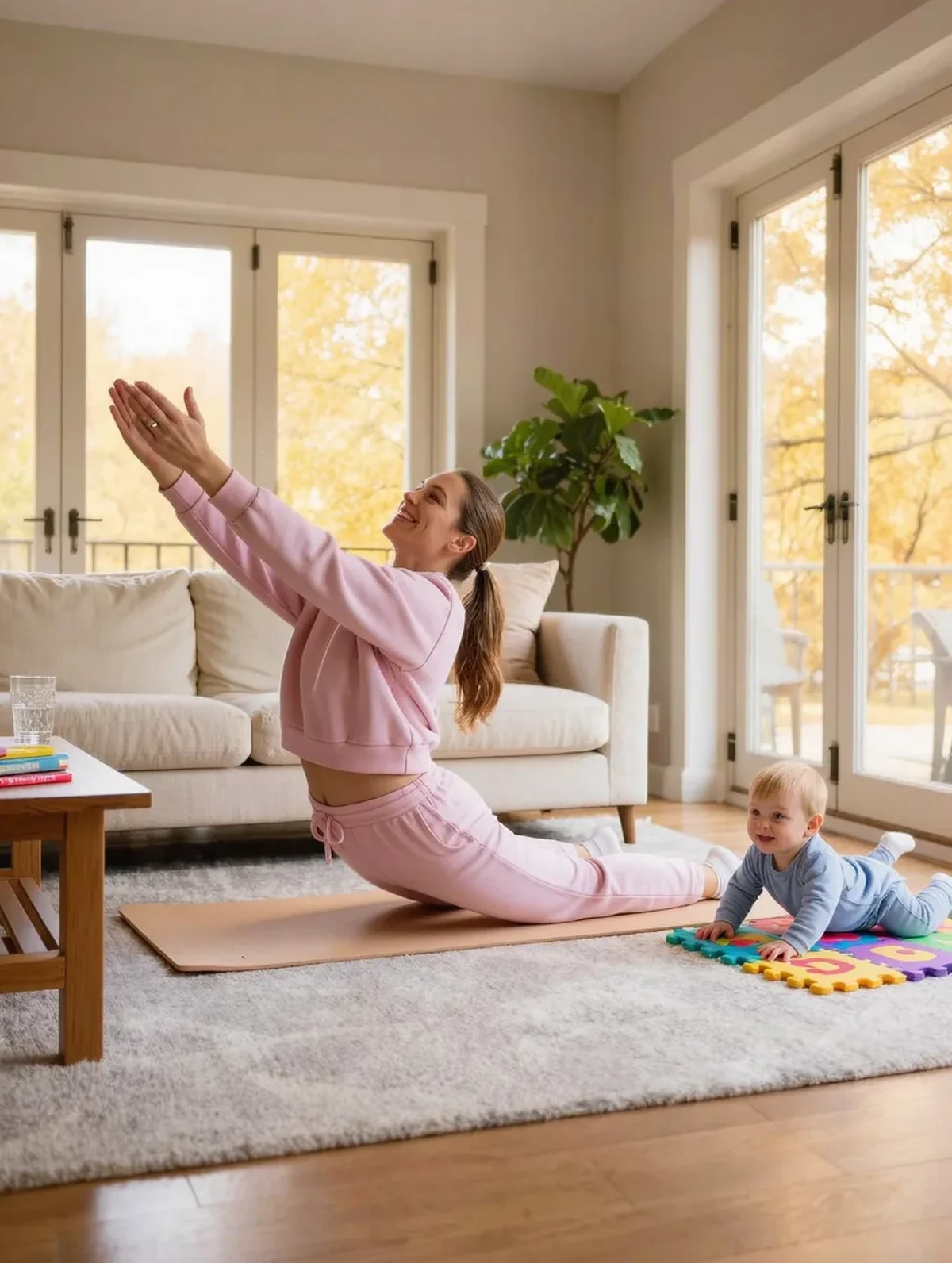
What actually changes physically when the baby becomes mobile?
The load profile of your day changes more than at any point since birth.
Floor-level lifting multiplies. A pre-crawling baby is picked up from a cot, a chair, a playmat — mostly at or above waist height. A crawling baby is picked up from the floor, and from wherever on the floor they have got to, usually in a hurry and usually at an awkward angle. For most people the number of daily lifts from below knee height goes from a handful to dozens.
The lifts get worse in shape, not just in number. A considered lift with both feet planted and a hinge at the hips is fine. A one-handed reach across a coffee table to catch a baby heading for the fireplace is not, and that is the version that now happens repeatedly. Twisting under load, at speed, with an asymmetric grip, is the single most provocative pattern for the low back and for a healing abdominal wall.
The baby is heavier and less cooperative. Somewhere between six and ten months most babies are roughly double their birth weight and actively resisting being carried. A squirming load is substantially harder to manage than a still one of the same weight because it moves your centre of mass unpredictably.
And you spend far more time down there yourself. Crawling age means hours a day on the floor supervising, kneeling, half-lying, twisting to intercept. That is a lot of time in sustained, unbalanced positions, and it often shows up as one-sided hip and low back stiffness that nobody connects to the milestone that caused it.
Why does the training plan fall apart specifically now?
Because it was quietly built on two assumptions that just stopped being true.
Assumption one: the baby stays where you put them. Almost every home workout with a baby in the room depends on this. Nap time, playmat time, bouncer time — all of it assumes containment. Crawling ends containment, and with it ends the twenty minute block. This is not a scheduling problem you can solve by getting up earlier; it is a structural change in what kind of session is possible while the baby is awake.
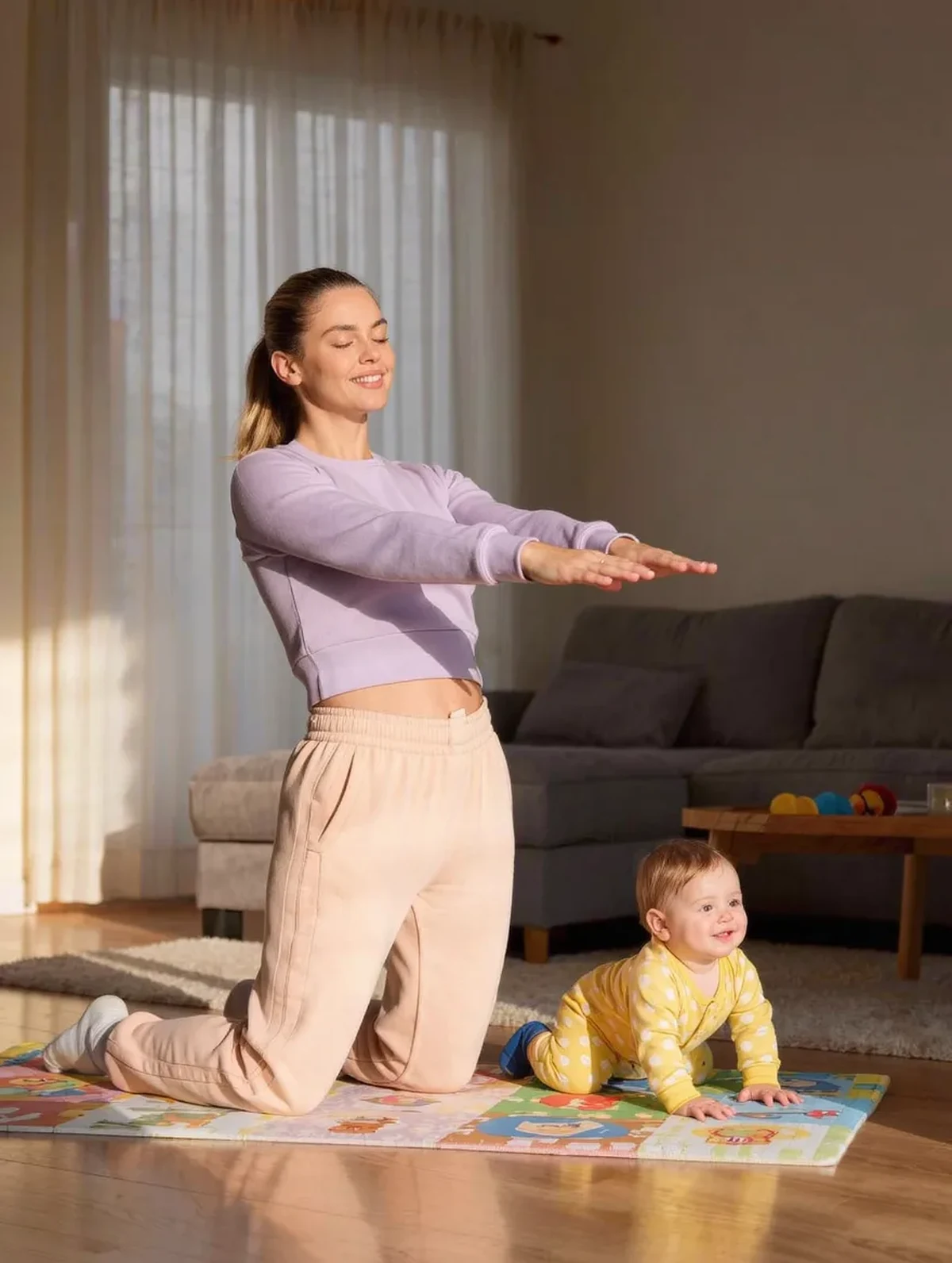
Assumption two: floor exercises are the easy option. For most of the first year the floor is the default training space: mat work, glute bridges, core rehab, stretching. A crawling baby treats a person lying on the floor as playground equipment. It is genuinely funny and it makes any sustained floor position impossible.
So the plan does not fail because you lost motivation. It fails because both of its foundations went at the same time, in the same week, without warning.
The other thing nobody flags: this often coincides with the month sleep improves. You finally have some energy, and the training gets harder to do anyway, which is a particularly demoralising combination if you do not know it is coming.
What should the training actually look like now?
Standing, short, and interruptible. Three principles, and they rebuild the whole plan.
Go standing. Move the bulk of the session off the floor. Standing work has an enormous practical advantage — you can stop mid-rep, intercept, and resume, and you can see the room. The good news is that standing work is also where the highest-value postpartum exercises live: squats, split squats, hinges, carries, standing presses and rows. Most people who make this switch end up with a better programme than they had.
Go short and stackable. Three blocks of seven minutes across a day beats one twenty-minute session that never happens. The physiological difference between one continuous session and three broken ones is small; the difference in whether it happens at all is enormous. Pick three exercises, do one block whenever a window opens, and count the day as complete when all three are done.
Train the pattern that is hurting you. The floor-to-standing lift is now your highest-volume daily movement, so train it deliberately. Deadlifts or kettlebell swings train the hinge. Goblet squats train the deep squat position you need to get to the floor. Turkish get-up variations, even just the first half, train getting up from the floor under control — which is precisely what you are doing thirty times a day.
And add carries, permanently. A squirming twenty-pound load carried on one hip is an enormous one-sided trunk demand. Suitcase carries are the closest training match and one of the best things you can do for the low back at this stage.
5 Mistakes People Make When the Baby Starts Moving
1. Trying to preserve the old session. The twenty-minute floor routine is gone for about eighteen months. Mourning it costs weeks. Rebuild for the conditions rather than waiting for the conditions to come back.
2. Lifting one-handed because the other hand is full. This is the specific mechanic behind most of the back pain that appears at this stage. If you are holding a phone, a cup or a toy, put it down before you lift. Two hands and a square stance, every time it is not an emergency.
3. Kneeling on one knee for hours. The half-kneel is the default supervising position, and almost everyone does it on the same side every time. Alternate consciously, or sit cross-legged and swap the front leg. One-sided hip pain at this stage is nearly always this rather than training.
4. Dropping strength work for walks. Walks are easier to do with a mobile baby, so they expand to fill the space. But the demand that just went up is strength — lifting a heavier, wrigglier load from floor level — and walking does not train it. Keep two strength sessions even if they are seven minutes each.
5. Assuming any new pelvic floor symptoms mean you went backwards. More lifting, more standing, more sudden loading — symptoms that were quiet can reappear now, and that is a load story rather than a recovery story. Manage the load, brace on the lift, and if it does not settle in two weeks, see a pelvic health physiotherapist.
How do you protect your back through the next six months?
One technique change and one habit, both small.
The technique: hinge, do not bend. Push the hips back, keep the chest forward, and let the knees bend as much as they need to. This is the same movement as a deadlift and it is trainable precisely because it is the same movement. Practise it deliberately ten times a day for a week — picking up toys is a perfect rehearsal — and it becomes automatic in time for the toddler stage, which is worse.
The habit: exhale on the effort. Breathe out as you lift, rather than holding your breath. Holding your breath spikes intra-abdominal pressure downward onto a pelvic floor that is already dealing with more load than it was three months ago. Exhaling on the lift is the single cheapest pelvic floor protection available and it costs nothing to implement.
Watch for the asymmetry. Almost everyone carries a baby on the same hip, lifts from the same side of the cot, and kneels on the same knee. Six months of that builds a measurable one-sided pattern. Deliberately alternate the carrying hip — it will feel wrong on the non-dominant side for about a fortnight and then it will not.
And know what is worth checking. New or worsening leaking, a feeling of heaviness or dragging in the vagina, or back pain that is sharp and localised rather than diffuse and achy are all worth a professional opinion rather than a training adjustment. All three are common at this stage and all three respond well to treatment.
FAQ: Training with a Newly Mobile Baby, Answered
My core felt fine and now it does not. Did I damage something?
Almost certainly not. The abdominal wall is being asked to do dramatically more twisting and lifting work than it was a month ago, and a return of doming or a feeling of weakness usually reflects the new load rather than an injury. Reduce the twisting under load, train the hinge, and reassess in two weeks. If doming is pronounced or there is pain, get it looked at.
How do I train when the baby will not let me put them down?
Wear them. A carrier turns squats, calf raises and walking lunges into loaded exercise, and the load is exactly the load you need to be strong for. Skip anything where you would be unhappy to lose balance.
Is this the point where I should join a gym with childcare?
For a lot of people, yes — this is the stage where home training becomes genuinely impractical and an hour with contained childcare is worth more than it was six months ago. It is a legitimate solution rather than an admission of defeat.
TL;DR:
- The crawling month triples your floor-level lifting, ends uninterrupted training blocks, and takes the floor away as a training space — all at once.
- Rebuild standing, short and stackable: three seven-minute blocks beat one twenty-minute session that never happens.
- Train the hinge deliberately, because floor-to-standing lifts are now your highest-volume daily movement. Add one-sided carries for the squirming load.
- Two hands on every non-emergency lift, exhale on the effort, and alternate the carrying hip.
This is one of the few postpartum setbacks that is entirely external — nothing about your recovery changed, the job description did. Plans that get rebuilt for the new conditions in week one tend to be stronger than what they replaced, mostly because everything that survives the rebuild is standing, loaded and genuinely useful.
See It in Motion
Seen here: Maternity Capris with Side Pockets — shop it on bubblelime.com
Keep Reading
This article is for general informational and styling purposes only. Fit, sizing, and product availability may vary.