Why Postpartum Running Goes Wrong in Week Three, Not Week One

Quick Answer: The first postpartum run feels manageable because it is one isolated bout on rested tissue. Problems appear at week three when frequency rises and cumulative load exceeds what the pelvic floor and connective tissue have recovered. Progress by adding one session per fortnight, not by extending each run.
Run one: cautious, short, and honestly quite good.
Run two, three days later: also fine.
Run six, around week three: leaking, heaviness, or a low back that will not settle. And nothing obvious changed.

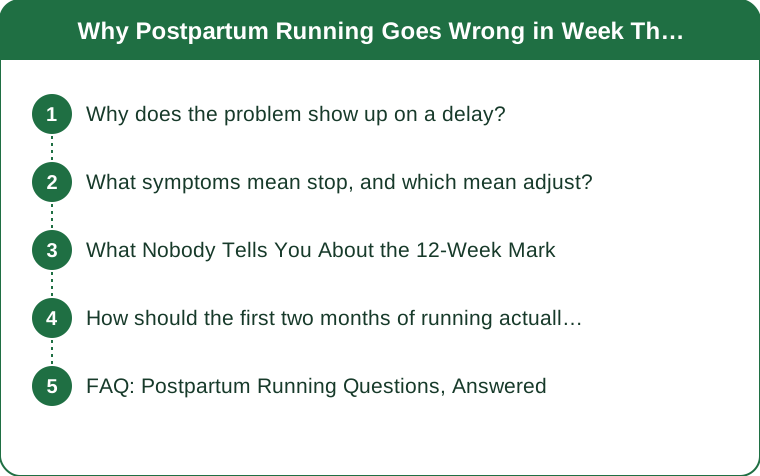
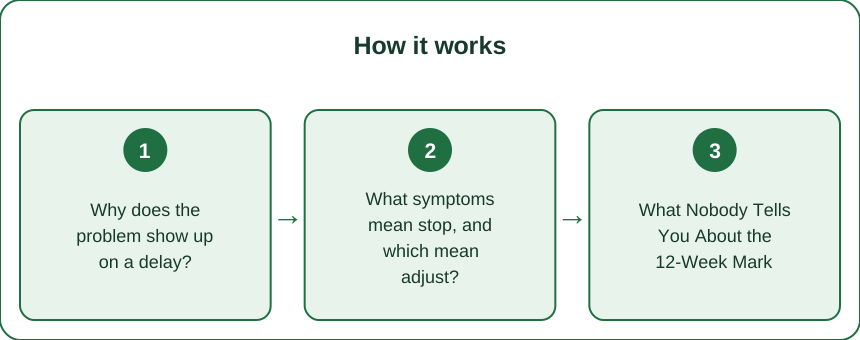
Why does the problem show up on a delay?
Because the tissues involved recover on a slower timeline than muscle, and cumulative load is what exposes them.
The pelvic floor, abdominal fascia, and the connective tissue around the pelvis undergo substantial remodelling during pregnancy and birth. Relaxin and other hormonal changes reduce tissue stiffness, and those effects persist for months after delivery — considerably longer than most return-to-exercise timelines account for, and longer still if you are breastfeeding.
A single run tests the tissue once. A pattern of runs tests its ability to recover between bouts, which is a different and more demanding question.
So week one, with one or two short runs and plenty of rest, sits inside capacity. By week three, the runs are more frequent, slightly longer, and the recovery windows have narrowed. Cumulative load crosses the line and symptoms appear — not because anything went wrong on that particular run, but because the total finally exceeded what the tissue could absorb.
This is why the symptom always feels like it came from nowhere. It did not. It came from the previous fortnight.
What symptoms mean stop, and which mean adjust?
Stop and get assessed: any leaking of urine during or after running. A sensation of heaviness, dragging, or bulging in the pelvis. Pain in the pubic symphysis or sacroiliac joints. Bleeding that restarts or increases.
Adjust the load: general muscular soreness that resolves in 48 hours. Mild fatigue. A feeling of weakness or instability that improves as you warm up.
The distinction that matters most is whether the symptom involves the pelvic floor. Muscular soreness is a training signal. Leaking and heaviness are load-tolerance signals, and pushing through them is associated with problems that take considerably longer to resolve than the few weeks of patience they would have cost.
Leaking during exercise is common — some studies put it near a third of postpartum runners — but common is not the same as normal or acceptable. It is treatable, and pelvic health physiotherapy has good evidence behind it.
This is general information, not medical advice. A pelvic health physio assessment before returning to running is the single most useful thing on this list, and in many places you can self-refer.

What Nobody Tells You About the 12-Week Mark
The commonly quoted guidance is that return to running is reasonable from around 12 weeks postpartum. What gets lost is the second half of that recommendation.
The 12 weeks is a minimum, not a green light, and it assumes you have built strength in the interim. Twelve weeks of doing nothing followed by running is a substantially different proposition from twelve weeks of progressive loading followed by running.
The strength markers used in return-to-running screening are genuinely demanding: single-leg calf raises, single-leg bridges, hopping in place, and single-leg squats, typically at 20 repetitions or 30 seconds. If those are difficult, running — which is a series of single-leg landings at two to three times bodyweight — is premature regardless of how many weeks have passed.
There is also a large individual range that the number obscures. Delivery type, tearing, previous training history, sleep, and whether this is a first or subsequent baby all shift the timeline considerably. Some people are ready at 12 weeks. Plenty are not ready until 6 months, and that is not a failure.
The number is a floor. The screening is the answer.
How should the first two months of running actually be structured?
Progress frequency first, duration second, intensity last.
Weeks 1 to 2: two sessions weekly. Walk 4 minutes, jog 1 minute, repeat 5 times. Twenty-five minutes total. Full rest day either side.
Weeks 3 to 4: still two sessions. Walk 3, jog 2, repeat 5 times. Note that duration barely moved — the change is in the ratio.
Weeks 5 to 6: three sessions weekly, back to the easier ratio for the new third session. This is the step where most people go wrong by keeping the harder ratio.
Weeks 7 to 8: three sessions, walk 2 jog 3, five rounds.
Throughout: two strength sessions weekly, non-negotiable. Single-leg work, glute bridges, calf raises, and pelvic floor training prescribed by a physio. The strength work is not a supplement to the running programme — it is the part that makes the running programme survivable.
The rule that prevents most problems: never increase frequency and duration in the same fortnight. One variable at a time.
FAQ: Postpartum Running Questions, Answered
Does it matter whether I had a caesarean or a vaginal birth?
Both need a similar pelvic floor approach, since pregnancy itself loads the pelvic floor regardless of delivery route. Caesarean adds abdominal wall healing considerations and usually a slightly longer timeline before impact.
Can I run while breastfeeding?
Yes. Feed or express before running for comfort, and be aware that hormonal tissue laxity persists while breastfeeding, which is a reason to progress gradually rather than a reason to avoid running.
What if I ran throughout pregnancy — can I go back faster?
A little, but less than you would expect. Pregnancy running maintains cardiovascular fitness well; it does not exempt the pelvic floor and connective tissue from the recovery timeline. The screening still applies.
TL;DR:
- Week three problems come from cumulative load, not from any single run.
- Leaking or heaviness means stop and get assessed; general soreness means adjust.
- Twelve weeks is a floor, not a green light — the strength screening is what actually decides readiness.
- Add frequency first, then duration, and never both in the same fortnight.
If you are in week three right now and something feels off, the useful move is not to push through and not to quit — it is to drop back two stages, book a pelvic health physio assessment, and keep the strength work going. Almost everyone who does that is running comfortably a few months later. This is general information, not medical advice.
See It in Motion
Seen here: Maternity Capris with Side Pockets — shop it on bubblelime.com
Keep Reading
This article is for general informational and styling purposes only. Fit, sizing, and product availability may vary.