Why You Get Dizzy Standing Up After Postpartum Floor Work (and the 20-Second Fix)

Quick Answer: You feel dizzy standing up after postpartum floor exercises because blood pools in your legs while you’re lying down and your body is slower than usual to push it back up to your head when you stand. After birth that reflex is weaker: your blood volume is still resetting, you’re often under-hydrated and under-fed, you’re sleep-deprived, and if you’re breastfeeding you need even more fluid. Get up in three stages over 20 seconds, pump your calves first, drink before you train, and eat within the previous 2 hours. Dizziness with fainting, a racing heart, chest pain, heavy bleeding or a severe headache needs a doctor the same day.
You did everything right. Bridges, dead bugs, clamshells, ten minutes on the floor while the baby napped. You stood up to grab your water and the edges of the room went grey.
It passed in a few seconds. But it’s happened three times this week, and before the baby it never happened at all.
Here’s why, and the simple way to get up that stops it.

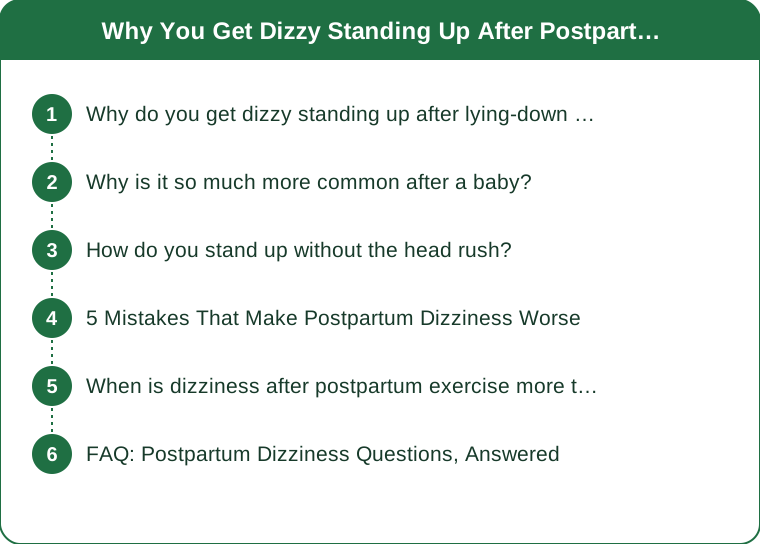
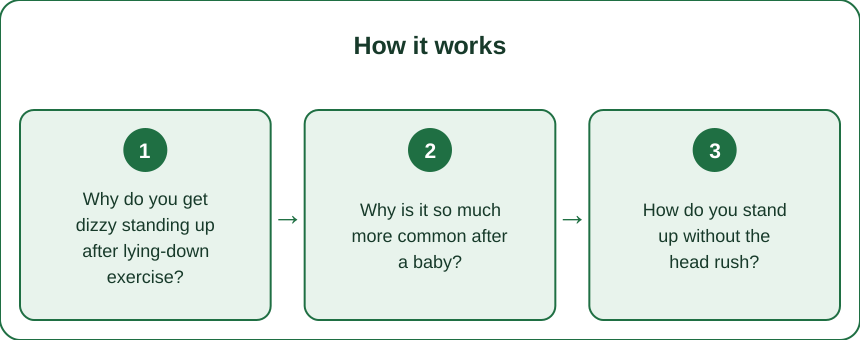
Why do you get dizzy standing up after lying-down exercise?
When you lie flat for 10 minutes, your blood spreads out evenly. When you stand, gravity pulls it into your legs and belly, and for a moment there’s less of it reaching your brain. Normally your body fixes this within a heartbeat or two: your blood vessels tighten, your heart speeds up, and blood pressure holds steady.
When that reflex is slow or weak, blood pressure dips for a few seconds, the brain gets slightly less flow, and you feel lightheaded, grey at the edges, or like the room tilts. Doctors call it orthostatic hypotension, and almost everyone has felt it at some point.
Floor exercise makes it more likely for two reasons. You’ve been horizontal for a while, so more blood has settled. And your leg muscles have been working and are full of blood, so when you stand up quickly, there’s extra pooling before the muscles start pumping it back.
Why is it so much more common after a baby?
During pregnancy your blood volume rose by roughly 40 to 50 percent. After birth it drops back toward normal over the first 6 to 8 weeks, and during that window your blood pressure regulation can be a bit unsettled. Blood loss during delivery, which is normal, can leave your iron stores lower than before, and low iron makes lightheadedness more common.
Then there’s daily life. Breastfeeding pulls fluid out of you all day. Most new mothers drink far less than they need because they’re feeding, holding or soothing with both hands. Skipped meals mean low blood sugar on top of low fluid. Broken sleep makes the whole blood-pressure reflex slower. And after months of less activity, the leg muscles that help pump blood upward are weaker than they were.
Stack all of that and you have a body that’s slower to catch its own blood pressure, standing up fast from the floor after a set of bridges. The dizziness is the predictable result, not a sign that you’ve done something wrong.
How do you stand up without the head rush?
Twenty seconds, three stages. It feels slow for the first week and then becomes automatic.
- Stage 1, on the floor: before you move, pump your ankles 10 times and squeeze your calves and thighs for 5 seconds. That pushes pooled blood back up.
- Stage 2, sitting: roll to your side and push up to sitting. Sit for a slow count of 5. If you’re already a little grey, sit longer.
- Stage 3, standing: come up through half-kneeling, push through the front foot, and stand with your feet apart. Stay still for 5 seconds before walking off. Keep a hand near the bed or wall.
Two more habits make the difference:
- Finish on your feet, not your back. End the session with 2 minutes of standing moves, like calf raises or marching, so the last thing you did wasn’t lying down.
- Exhale on every effort. Holding your breath during bridges or dead bugs spikes pressure in your chest and then drops it when you release, which adds to the dip when you stand.
If you feel it coming on, don’t try to walk it off. Sit or lie down, legs up on the sofa, until it passes. It’s not dangerous in itself, but falling with a baby nearby is.

5 Mistakes That Make Postpartum Dizziness Worse
- Training on an empty stomach. A 10-minute floor session at 7am before you’ve eaten, on top of a night feed, is the most common setup for a grey-out. Eat something with carbohydrate and protein within 2 hours of training. A banana and a spoon of peanut butter is enough.
- Starting dehydrated. If you breastfeed, you need roughly an extra 3 to 4 cups of fluid a day on top of your normal intake. Drink a large glass 30 minutes before the session and keep the bottle on the mat.
- Hot rooms. Warmth widens blood vessels and makes pooling worse. Train in a cool room, and skip the hot shower immediately afterward.
- Long static holds. Holding a glute bridge or a plank for 60 seconds while holding your breath is a recipe for a pressure drop. Use reps, 10 to 12, with a breath on every one.
- Jumping straight to the baby. The baby wakes, you leap up from the floor and rush to the crib. That’s the fastest stand of the day and the most dangerous place to go grey. Sit first, then stand, then go. Ten seconds won’t hurt the baby.
When is dizziness after postpartum exercise more than a blood-pressure dip?
Most of the time this is a harmless dip that improves within weeks as your fluid, food and sleep improve. Get seen the same day, or call your provider, if any of these go with it:
- You actually faint, or nearly faint more than once.
- Your heart races or pounds, or you feel it skipping.
- Chest pain, pressure or shortness of breath.
- Bleeding that’s heavier than a period, or any bleeding after it had stopped.
- A severe headache, vision changes, or swelling in your face or hands. Blood pressure problems can still appear in the weeks after birth.
- Dizziness that’s there all the time, not just on standing.
Ask your provider to check your iron and your blood pressure. Low iron after birth is common and easy to treat, and fixing it often ends the dizziness. This is general information, not medical advice.
FAQ: Postpartum Dizziness Questions, Answered
How long does postpartum dizziness on standing last?
For most women it improves a lot by 8 to 12 weeks as blood volume settles and sleep, food and fluid get more regular. If you’re still getting lightheaded most days after 3 months, or it’s getting worse, get your iron and blood pressure checked.
Is it safe to keep exercising if I get dizzy?
Usually yes, with the adjustments above: eat and drink first, cool room, reps instead of holds, exhale on effort, and the 20-second stand. If it happens despite those, or with any of the warning signs, stop and get checked before continuing.
Does breastfeeding cause the dizziness?
It contributes. Breastfeeding raises your fluid needs and can lower blood pressure slightly during a feed. Many mothers notice the dizziness most if they train right after a feed without drinking. Have a large glass of water before and after feeds, and train between feeds rather than straight after one.
TL;DR:
- Dizziness standing up after floor exercise is a brief blood-pressure dip, and after birth the reflex that prevents it is slower because of resetting blood volume, low fluid, low iron, skipped meals and broken sleep.
- Stand up in three stages over 20 seconds: pump the calves, sit for 5, rise through half-kneeling and pause.
- Eat within 2 hours and drink a large glass before training, use reps not long holds, and finish standing.
- Fainting, a racing heart, chest pain, heavy bleeding or a severe headache mean a same-day call to your provider.
Try the three-stage stand in your next session. For most mothers that alone ends the grey-outs, and a glass of water and a snack before training handles the rest. This is general information, not medical advice.
See It in Motion
Seen here: Maternity Capris with Side Pockets — shop it on bubblelime.com
Keep Reading
This article is for general informational and styling purposes only. Fit, sizing, and product availability may vary.