Returning to Exercise After a Difficult Birth (A Slower, Kinder Timeline)

Quick Answer: The standard six-week postpartum timeline was written for an uncomplicated birth. After tearing, surgery, or complications, get medical clearance first, then start with breathing, gentle pelvic floor work and 5–10 minute walks. Progress by symptoms — pain, bleeding, or heaviness means stop — not by the calendar. A pelvic health physiotherapist is the single highest-value referral you can get.
Six weeks. That’s the number everyone gives you, and for a lot of women it’s the number that makes them feel like they’re failing.
Because that timeline assumes a birth many women didn’t have. If yours involved surgery, significant tearing, or complications, you’re not behind schedule — you’re on a different schedule, and nobody handed you a copy of it.

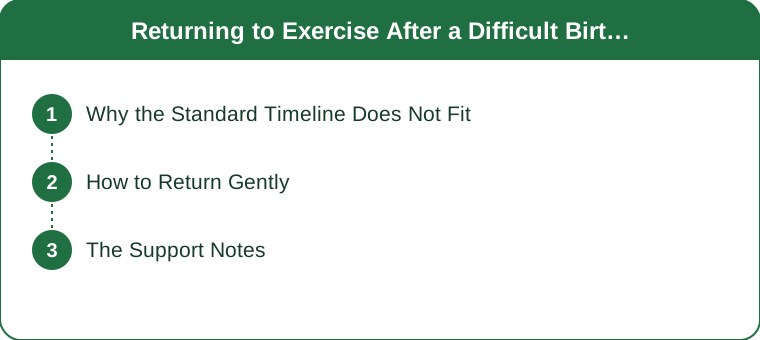
Why Doesn’t the Standard Postpartum Timeline Fit?
It assumes an uncomplicated recovery. Standard timelines are built around a straightforward vaginal birth with no complications. That’s the baseline case, not every case.
Complications change everything. A caesarean is major abdominal surgery. Third or fourth degree tearing is a significant repair. Haemorrhage, infection, or an extended hospital stay all reset the clock — and none of them are reflected in a generic six-week number.
Comparison actively causes harm. Measuring your recovery against someone whose birth went differently produces genuine distress and no useful information. The comparison isn’t just unhelpful; it’s not even valid.
Healing isn’t linear. You’ll have a good week and then a worse one. That’s how tissue recovery goes, and it doesn’t mean you’ve gone backwards or done something wrong.
Mental recovery counts as recovery. A frightening or traumatic birth leaves its mark, and psychological recovery runs on its own timeline alongside the physical one. Both are real. Only one shows up in the six-week check.

How Do You Return to Exercise Gently?
In order. Don’t skip ahead — the order is the whole method.
Medical clearance first. Non-negotiable, and worth more than a yes/no. Ask specifically what you’re cleared for, and what would be a reason to stop.
Start with breathing and gentle core connection. Not an exercise in the way you mean it — this is the foundation everything else sits on. Slow exhales with a gentle drawing-in of the lower belly, 5–8 breaths, a few times a day.
Walking is your first real exercise. Five to ten minutes, on flat ground, at a comfortable pace. If it feels absurdly easy, that’s the correct starting point.
Pelvic floor work goes in early. Gentle, and early — including after a caesarean, where the pelvic floor still carried a pregnancy even if it didn’t do the delivery.
Sessions should be very short. Five or ten minutes genuinely counts. Two short walks beat one long one you pay for the next day.
Progress on symptoms, not on dates. The rule: if today’s amount produced no pain, no increase in bleeding, and no heaviness, then that amount is available again. Add roughly 10% at a time, and only after a few comfortable repetitions.
Delay impact until well ready. Running, jumping and HIIT come much later than anyone wants — typically months, and after a pelvic health assessment. Impact is the last thing to return, not an early milestone.
Stop for pain, increased bleeding, or heaviness. Those three are your signals. Heaviness or dragging in the pelvis in particular is a stop-and-get-assessed sign, not a push-through one.
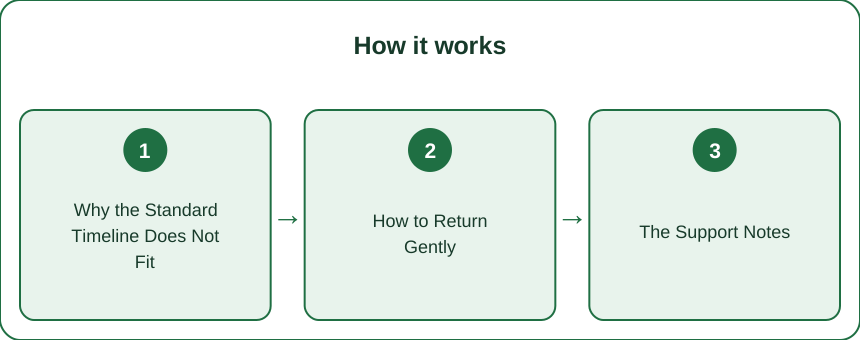
What Support Should You Actually Get?
A pelvic health physiotherapist, first. This is the highest-value referral available to you and it’s dramatically under-used. They assess what’s actually happening rather than guessing from a calendar, and they’ll tell you what you’re ready for — which is far more useful than being told what week you’re in.
Keep your provider informed. Tell them what you’re actually doing, not what you think you should be doing. They can only account for what they know about.
Treat mental health support as part of recovery. If the birth was frightening, or you’re having intrusive memories, persistent low mood or anxiety, that’s a treatable thing and it belongs in the recovery plan alongside the physical work.
Don’t compare timelines. Not with friends, not with the internet, not with your own previous birth. Different starting conditions produce different timelines, and that’s arithmetic rather than character.
Find honest community. Groups that talk openly about difficult recoveries are worth their weight. The curated version of postpartum recovery online is a poor reference point and a worse benchmark.
Fitness does come back. Genuinely. Slower than you’d like, and often via a route you didn’t plan, but a delayed return is not a cancelled one.
Be kind to yourself. You are recovering from a difficult birth while caring for a newborn on broken sleep. That’s the actual context — grade yourself against that, not against a six-week leaflet.
What Nobody Tells You
- A caesarean is abdominal surgery. You’d never expect someone to be “back to normal” six weeks after any other abdominal operation.
- The six-week check is a screening, not a clearance for everything. “Fine” at that appointment does not mean “ready to run.”
- The pelvic floor is affected by pregnancy, not only delivery. A caesarean does not exempt you from pelvic floor work.
- Sleep deprivation delays tissue healing. Some of the slowness isn’t the birth — it’s the 3am feeds.
- You can be cleared and still not be ready. Clearance is a floor, not a verdict on how you feel.
Frequently Asked Questions
When can I start exercising after a C-section?
After clearance from your provider, usually around 6–8 weeks for gentle activity — but that’s the start of walking and breathing work, not the gym. Loaded core work and impact come considerably later, ideally after a pelvic health physiotherapy assessment.
How do I know if I’m doing too much?
Three signals: pain, an increase in bleeding, or a feeling of heaviness or dragging in the pelvis — during the activity or in the 24 hours afterwards. Any of them means scale back to the last amount that felt fine and hold there for a week.
Is it normal to still feel unfit at six months?
Yes, and it’s extremely common after a difficult birth. Six months with a baby who wakes at night is a very different six months from six months of undisturbed training. Fitness returns, but the timeline is honestly measured in seasons.
What should I wear for those first short walks?
Whatever removes friction from actually going. Something soft-waisted that doesn’t press on a caesarean scar matters — high waist leggings with a wide, gentle band sit above the incision line rather than across it, which is the difference between a walk you take and one you talk yourself out of.
When to See a Professional
Contact your provider for increased or bright red bleeding, fever, worsening pain, or any wound that looks inflamed or opens. See a pelvic health physiotherapist for leaking, pelvic heaviness, pain during sex, or before returning to running. And speak to your doctor about intrusive memories of the birth, persistent low mood, or anxiety — postpartum mental health is treatable and shouldn’t be waited out. This article is general information, not medical advice.
TL;DR:
- The standard timeline assumes an uncomplicated birth — measuring yourself against it after complications isn’t a fair comparison.
- Order matters: clearance → breathing and gentle core → short walks → early pelvic floor work.
- Keep sessions to 5–10 minutes at first and progress by symptoms, not dates.
- Pain, increased bleeding, or pelvic heaviness means stop and step back.
- Impact work comes last, typically months out and ideally after a pelvic health assessment.
- A pelvic health physiotherapist is the highest-value referral available; mental health support is part of recovery, not separate from it.
See It in Motion
Seen here: Maternity Capris with Side Pockets — shop it on bubblelime.com
Keep Reading
This article is for general informational and styling purposes only. Fit, sizing, and product availability may vary.