Postpartum Movement for Mental Health: How Gentle Exercise Supports Your Mind (Not Just Your Body)

Quick Answer: Gentle postpartum movement helps your mind as much as your body — mood, energy and a sense of being yourself again. Ten to twenty minutes of walking, ideally outside, is enough to feel a difference. This is support, not treatment: if you’re struggling with your mood beyond the first couple of weeks, tell your provider. Postpartum depression and anxiety are common and treatable.
Everyone asks about the baby weight. Almost nobody asks whether you feel like yourself.
But if you talk to women six months out, the thing they say movement gave back wasn’t a dress size. It was twenty minutes a day that belonged to them, and a mood that stopped sliding.
That’s the part worth protecting — and it’s available at a far lower dose than any fitness plan asks for. (This isn’t medical advice; see your provider.)

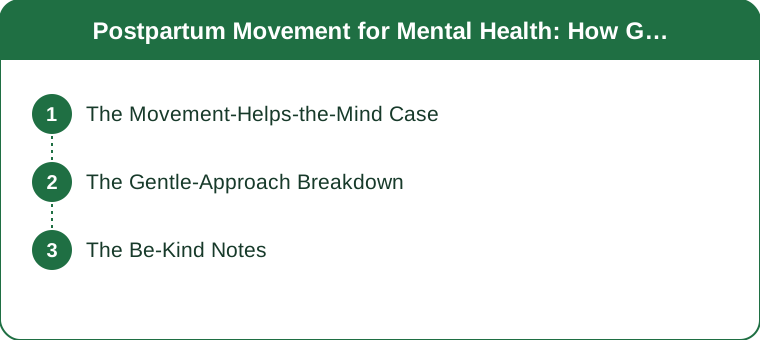
How Does Exercise Actually Help Postpartum Mental Health?
Not through willpower or “endorphins” hand-waving. Through a few concrete mechanisms:
Mood regulation. Regular moderate movement is one of the better-supported non-drug supports for low mood. It doesn’t replace treatment, but it stacks on top of it.
Energy, counter-intuitively. Gentle movement usually raises baseline energy over a few weeks, even on broken sleep. The 20-minute walk you don’t feel like taking often leaves you with more left than you started with.
Daylight. Morning light exposure helps anchor a circadian rhythm that a newborn has thoroughly dismantled. This is one of the reasons an outdoor walk beats the same walk on a treadmill.
A sense of self. Postpartum life is relentlessly other-directed. Movement is a block of time where your body is doing something for you. That matters more than the calorie count of it ever will.
Connection. A walk with a friend or a stroller group is movement plus adult conversation — and isolation is one of the strongest risk factors for postpartum mood problems.

How Much Movement Do You Actually Need?
Far less than the internet implies. For mood benefit, the useful dose is roughly 10–30 minutes of easy movement, most days. That’s it.
A realistic version:
- Minimum viable day: 10 minutes outside with the stroller.
- Good day: 20–30 minutes walking, ideally in daylight.
- Great week: 4–5 of those, plus one thing you’d genuinely call fun.
Notice what’s not on that list: intensity, a gym, or a plan you have to follow. Consistency at a low dose beats intensity you can only manage twice a month.
Everything should be provider-cleared and diastasis-safe — gentle cardio after baby, nothing that makes your belly dome, nothing that leaves you leaking or feeling heavy in the pelvis. The mental benefit disappears fast if the movement is setting your recovery back.
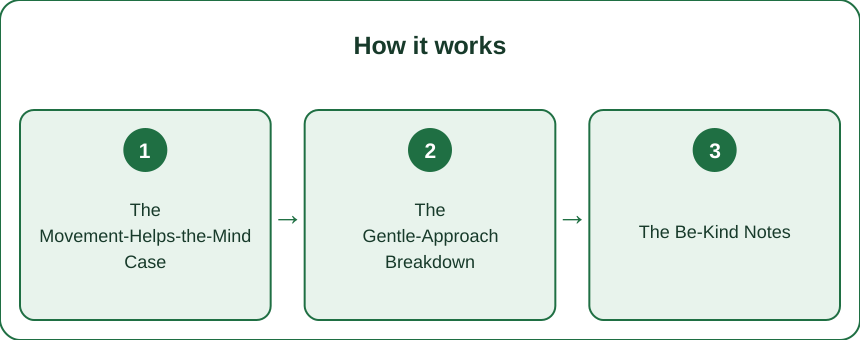
Which Kinds of Movement Help Your Mind Most?
Walking outdoors is the highest return per minute. Light, motion, a change of walls, and it works with a stroller. Start with what you can do without dread — 10 minutes counts.
Movement with other people. A stroller-walk group, a postnatal class, a friend who’ll walk laps of a park with you. The social element does independent work.
Gentle strength or mobility. Ten minutes of glute bridges, pelvic tilts and shoulder mobility while the baby is on the mat next to you. Feeling physically capable again is its own mood lever.
Something rhythmic. Swimming, cycling, dancing in the kitchen. Repetitive rhythm has a settling effect that a to-do-list workout doesn’t.
Whatever you’d actually enjoy. Adherence beats optimization by a mile at this stage.
5 Things Nobody Tells You About Movement and Postpartum Mood
-
The first 5 minutes are the worst 5 minutes. Almost every walk you don’t want to take feels fine by minute six. Make the deal with yourself for five minutes only.
-
Guilt cancels most of the benefit. Movement framed as “burning off” pregnancy weight tends to worsen body image, not improve it. Same walk, different frame, different outcome.
-
A little is not a lesser version. Ten minutes isn’t a failed thirty. On the mood side, the difference between zero and ten minutes is larger than the difference between ten and thirty.
-
Exercise is not a treatment for postpartum depression. It’s a helpful support alongside proper care. If your low mood, anxiety or intrusive thoughts persist past two weeks, or you can’t function, that’s a call to your provider — not a sign you need to walk harder.
-
The fifth one surprises people most: the days you least want to move are, statistically, the days it helps most — and also the days it’s most reasonable to skip. Both are true. Aim for often, not perfect.
How Do You Be Kind to Yourself About This?
Start by dropping the timeline. Recovery is measured in months, not weeks, and the mental side has its own clock that has nothing to do with how your body looks.
Practical kindness that actually works:
- Lower the bar until you can’t refuse it. Shoes on, out the door, 10 minutes.
- Stack it onto something you already do — the afternoon nap, the school run, the trip to the shop.
- Skip without penalty. Never miss twice is a better rule than never miss.
- Don’t diet at the same time. Under-fuelling while sleep-deprived makes mood worse, not better.
- Make it comfortable. Postpartum bodies change for months; a soft, high waist legging or maternity capri that doesn’t dig at the waistband or press on a scar removes one of the most common reasons a walk gets skipped.
And say the quiet part out loud to someone: if you’re not okay, tell your provider, your health visitor, or your partner. Postpartum depression and anxiety affect roughly one in seven new mothers. They’re common, they’re not your fault, and they respond well to treatment.
FAQ
Can exercise treat postpartum depression?
No — but it’s a genuinely useful support alongside proper treatment. Studies consistently show moderate exercise improves mood scores in new mothers, and it’s often recommended as part of a plan. It doesn’t replace talking to a provider, therapy, or medication when those are needed.
How soon after birth can I start moving for my mental health?
Short, gentle walks are often fine within the first weeks with your provider’s okay, and that’s where most of the mood benefit lives anyway. Structured exercise usually waits for your postnatal clearance — around 6 weeks after an uncomplicated vaginal birth, later after a c-section.
What if I’m too exhausted to exercise?
Then shrink it, don’t skip it. Five minutes of standing outside with the stroller counts, and it often creates energy rather than spending it. If exhaustion is total and unrelenting rather than the ordinary broken-sleep kind, that’s worth mentioning to your provider — thyroid changes and anaemia are both common postpartum.
TL;DR:
- Movement’s biggest early postpartum benefit is mental: mood, energy, identity, connection.
- The useful dose is small — 10–30 minutes of easy movement, most days, ideally outside.
- Walking is the anchor; add gentle strength, something rhythmic, and other people.
- Keep it provider-cleared and diastasis-safe; stop for leaking, heaviness or doming.
- No weight-loss framing, no timeline, no guilt — and no dieting on broken sleep.
- Exercise supports mood; it doesn’t treat postpartum depression. Persistent low mood means call your provider.
See It in Motion
Seen here: Maternity Capris with Side Pockets — shop it on bubblelime.com
Keep Reading
This article is for general informational and styling purposes only. Fit, sizing, and product availability may vary.