Why Comparing Your Postpartum Recovery to Anyone Else's Is Setting You Up to Feel Behind

Quick Answer: Birth type, degree of abdominal separation, pre-pregnancy baseline, available sleep, and household support all move a recovery timeline independently of effort. Two recoveries were never going to match. The only fair comparison is this week against last week.
Someone in your feed was back at the gym at six weeks. Your sister bounced back faster with her second. A stranger’s caption says “trust the process” over a photo you can’t stop thinking about.
None of those posts mention how the baby slept. That’s not an accident of editing — it’s just not what photos show.

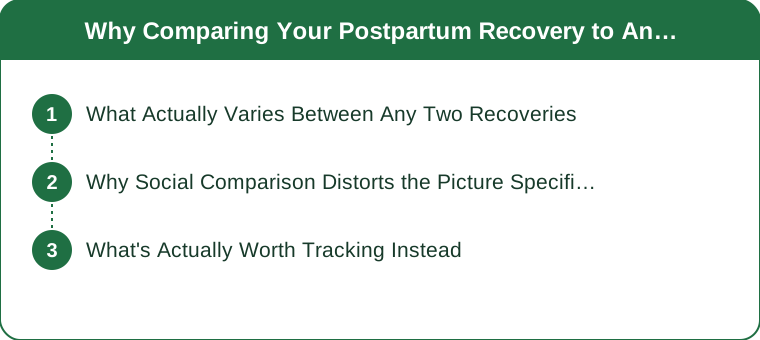
What actually varies between two recoveries?
Birth type. A vaginal delivery and a cesarean involve fundamentally different tissue healing processes. Those timelines were never going to match regardless of fitness going in — our c-section timeline guide covers how differently they run.
Degree of abdominal separation. Diastasis severity varies significantly between individuals for reasons unrelated to effort, and it directly affects when certain core and cardio work becomes appropriate.
Pre-pregnancy baseline. Someone very active beforehand often — though not always — has more baseline strength to rebuild from. That’s a starting point, not a measure of postpartum effort.
Sleep and help. How much either is actually available varies enormously between households, and it directly determines energy for any movement at all. This one has nothing to do with physical healing and frequently matters more than everything above it.
Which pregnancy this is. A body that has carried multiple pregnancies often recovers on a different pattern — which makes even comparison to your own previous recovery unreliable.
Why does social comparison distort this specifically?
- Outcomes without context. A six-week photo shows a result with no visible information about birth type, support, or how that body responded to pregnancy.
- Biased sampling. Smooth, fast recoveries are disproportionately likely to get posted. Harder ones stay private. You’re seeing a filtered slice, not a distribution.
- Terrible timing. Comparison happens during significant hormonal shift and sleep deprivation, when self-critical thinking is already elevated.
- Even friends smooth the story. Not out of dishonesty — memory and storytelling naturally sand off the hardest parts.
- It’s counterproductive on its own terms. The stress it generates interferes with the rest that recovery actually requires.

What Nobody Tells You
The six-week appointment is a clearance check, not a starting gun. It confirms healing is on track. It doesn’t mean a body is ready for what it did before, and nobody schedules a second appointment to say so.
Energy and strength recover on different timelines. You can be objectively stronger than last month and feel worse, because sleep debt is running the show. Conflating the two makes real progress invisible.
Month four is often harder than month two. Support fades, novelty wears off, and expectations rise — a well-documented dip that nobody warns about because month two got all the attention.
“Bounced back” describes visibility, not function. A visible waistline says nothing about pelvic floor function, core coordination, or whether running is safe yet. The visible marker and the functional one are barely related.
Second recoveries follow their own rules. They differ from first ones enough that your own history isn’t a reliable benchmark either.
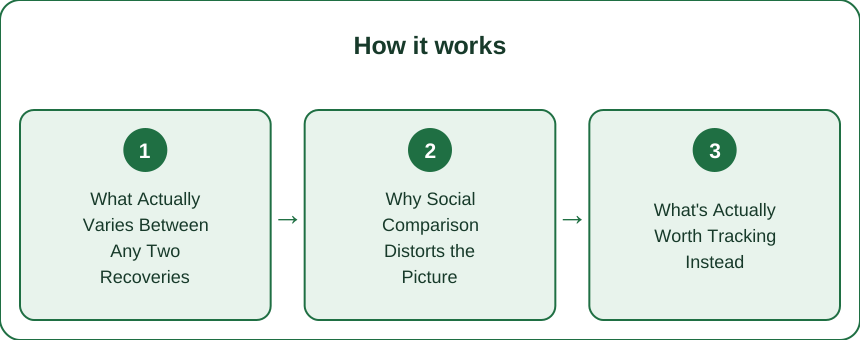
What’s worth tracking instead?
This week versus last week. It’s the only comparison with matched variables — same body, same birth, same household.
Function over appearance. Carrying the baby comfortably, walking a certain distance, getting through a feed without back pain. Practical capability tells you more than weight or a mirror.
Trend direction on discomfort. Is a specific discomfort trending down across successive weeks? That’s more informative than any single day’s snapshot.
Energy, tracked separately. Because energy and strength recover on different clocks, tracking them together hides progress in both.
Concrete milestones with a professional. Ask a doctor or pelvic health physical therapist about your specific next steps rather than whether you’re on some generic average schedule.
When to see a professional: ongoing pain, urinary or bowel leaking, a feeling of heaviness or bulging in the pelvis, a gap in the abdominal wall that isn’t improving, or bleeding that restarts after it had stopped all warrant a call to your doctor or midwife rather than waiting it out. A pelvic health physical therapist is the right referral for most return-to-exercise questions, and in many places you can self-refer. And if low mood, anxiety, or intrusive thoughts are part of the picture, tell your provider — postpartum mental health conditions are common, treatable, and not something to measure yourself against anyone else on either.
FAQ
How long does postpartum recovery actually take?
Longer than the six-week appointment implies. Tissue healing, pelvic floor function, and return to previous activity run on separate and largely individual timelines — our realistic timeline walks through what tends to change when, with the honest caveat that ranges are wide.
Is it normal to feel behind at three months?
Extremely. Three months is often when outside support has thinned but sleep hasn’t improved, so capability plateaus while expectations climb. Feeling behind at that point usually reflects the comparison, not the recovery.
Should I stop following fitness accounts entirely?
You don’t have to, but curating helps more than willpower. Following accounts that show context — birth type, timelines, setbacks — changes what you’re comparing against far more effectively than trying not to compare.
TL;DR:
- Birth type, diastasis severity, pre-pregnancy baseline, sleep, and support all move timelines independently of effort.
- Social comparison shows outcomes without context, from a sample biased toward easy recoveries, during a window when self-criticism is already elevated.
- Even your own previous recovery isn’t a reliable benchmark.
- Track this week against last week, using function and energy rather than appearance.
- Energy and strength recover on different clocks — measure them separately.
- Pain, leaking, pelvic heaviness, a non-closing gap, restarted bleeding, or low mood all warrant a call to your provider; a pelvic health PT is the right referral for return-to-exercise questions.
See It in Motion
Seen here: Maternity Capris with Side Pockets — shop it on bubblelime.com
Keep Reading
This article is for general informational and styling purposes only. Fit, sizing, and product availability may vary.